Today marks a defining moment in international diplomacy as Prime Minister Narendra Modi welcomed German Chancellor Friedrich Merz to Ahmedabad for the highly anticipated India-Germany Summit 2026. This visit, Merz’s first to Asia since assuming office, is a powerful testament to the deepening strategic partnership between these two economic giants. The atmosphere was charged with camaraderie as the leaders paid floral tributes at the Sabarmati Ashram and participated in the colorful Kite Festival, signaling a relationship that goes far beyond mere diplomatic formalities. Celebrating twenty-five years of strategic partnership, both leaders reaffirmed their dedication to a rules-based international order, a vital stance given the current shifts in global geopolitics.The summit delivered substantial outcomes, most notably a major overhaul in defense and security. Moving away from traditional buyer-seller dynamics, the two nations agreed on a new Defense Industrial Cooperation Roadmap. This agreement focuses on the co-development and co-production of military hardware, aligning perfectly with PM Modi’s Make in India initiative. It promises to boost indigenous manufacturing capabilities by leveraging world-class German engineering. Beyond defense, the delegations exchanged nineteen Memorandums of Understanding (MoUs) covering critical sectors such as semiconductors, supply chain resilience, and critical minerals. Germany also committed a massive €1.24 billion to support India’s green hydrogen and renewable energy projects, cementing their joint fight against climate change.For the general public, the most exciting announcement was regarding travel facilitation. Germany has officially approved visa-free transit for Indian passport holders, significantly easing the journey for travelers connecting through German airports to other destinations. In addition to this travel perk, a new framework was introduced to streamline the recruitment of Indian healthcare professionals, addressing labor shortages in Europe while opening doors for Indian talent. With talks of the EU-India Free Trade Agreement potentially concluding by the end of the month, and the establishment of a new CEO Forum, the summit has set a robust foundation for future economic growth. As Chancellor Merz heads to Bangalore for further tech engagements, the message is undeniable: the India-Germany partnership is stronger than ever.
The Strategic Pivot: Why the 2026 Summit Matters
The India-Germany Summit 2026 arrives at a crucial juncture—marking 75 years of diplomatic relations and 25 years of a formal Strategic Partnership. Unlike previous ministerial meetings, this summit focused on “future-proofing” bilateral ties against global instability, emphasizing sovereign tech stacks and resilient supply chains.
Key Objectives of the Summit:
- Economic Integration: Finalizing the roadmap for the India-EU Free Trade Agreement (FTA).
- Defense Autonomy: Moving from a buyer-seller relationship to joint co-production.
- Green Energy Leadership: Accelerating the Green and Sustainable Development Partnership (GSDP).
- Technology Sovereignty: Collaborative frameworks for AI, semiconductors, and 6G.
1. Defense and Security: A New Frontier
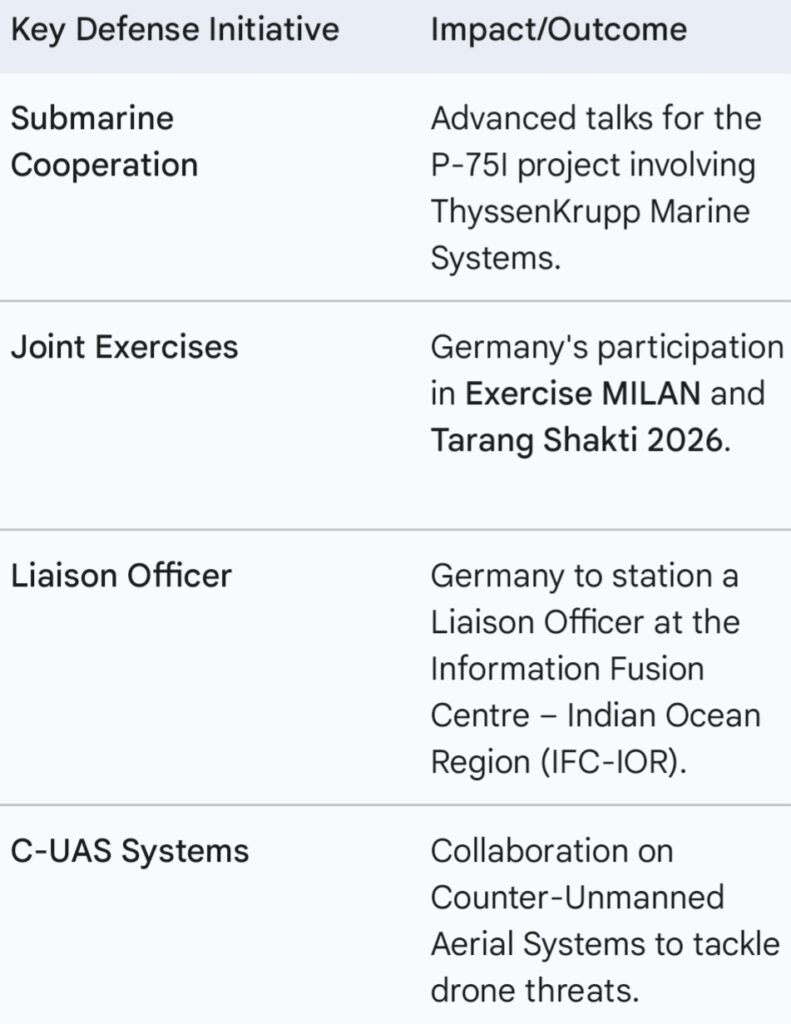
One of the most historic outcomes of the India-Germany Summit 2026 is the signing of the Defence Industrial Cooperation Roadmap. Germany, traditionally cautious with arms exports, has pivoted to view India as a primary strategic partner in the Indo-Pacific.
”Rough winds are blowing in world politics… India and Germany should increase partnership to counter global trends of instability.” — Chancellor Friedrich Merz
2. The Green Hydrogen & Climate Action Synergy
As the world’s two largest democratic economies, the focus on the Green Hydrogen Roadmap was a centerpiece of the 2026 talks. India’s goal to become a global hub for green hydrogen production matches Germany’s need for clean energy imports to fuel its industrial heartland.
- German-Indian Centre of Excellence: A new hub for green technology and climate innovation was established.
- Offtake Agreements: Major deals were signed between Indian firms (like AM Green) and German giants (Uniper) for Green Ammonia exports.
- GSDP Half-Time Review: Leaders noted that 2026 marks the midway point for the Green and Sustainable Development Partnership, with €10 billion in German commitments being effectively deployed.
3. Technology and the Digital “Chakra”
During the India AI Impact Summit 2026 (concurrent with the bilateral visit), Prime Minister Modi and Chancellor Merz emphasized that AI must be “Safe, Trusted, and Inclusive.”
Significant Tech Agreements:
- Semiconductor Ecosystem Partnership: Joint R&D and manufacturing to reduce dependence on single-source supply chains.
- Critical Minerals MoU: Securing the “lithium and cobalt” supply chain essential for the EV revolution.
- Digital India Act (DIA) Alignment: Dialogues on regulatory frameworks for AI and deepfake mitigation.
4. Labor Mobility: Opening the Doors for Talent
In a move to address Germany’s labor shortage and India’s demographic dividend, the India-Germany Summit 2026 saw a massive boost in skilled migration pathways. Germany has increased the annual visa quota for skilled Indian professionals to 90,000, focusing on healthcare, IT, and engineering.
Conclusion: A Partnership for the Global Good
The India-Germany Summit 2026 has proven that the relationship is no longer just about trade—it’s about shared values and mutual survival in a complex world. By combining German precision with Indian scale, the two nations are setting a blueprint for how a “Global North” power and a “Global South” leader can co-create a sustainable future.
The “New Era of Friendship” isn’t just a headline; it is a $100 billion economic roadmap in the making.