Today, February 12, 2026, the eyes of the world are fixed on South Asia as the Bangladesh General Elections take place. This is not just a routine exercise of franchise; it is a monumental event marking exactly 18 months since the “Monsoon Revolution”—the 2024 student uprising that ended fifteen years of Awami League rule.
As millions of voters head to the booths, the nation stands at a crossroads, balancing the hope for a new democratic era against the challenges of a deeply reconfigured political landscape.
The Shadow of the 2024 Student Uprising
The journey to this election began in the streets of Dhaka in July and August 2024. What started as a protest against job quotas evolved into a mass movement that led to the ouster of Sheikh Hasina. Since then, an interim government led by Nobel Laureate Dr. Muhammad Yunus has managed the country’s transition.
These elections are widely viewed as the ultimate “stress test” for the reforms initiated after the uprising. For the youth—who make up nearly 44% of the electorate—this is their first opportunity to cast a vote in an environment free from the dominance of the previously ruling party, which has been legally barred from these polls.
High-Stakes Voting: Security and Surveillance
Security is the top priority for the Election Commission today. Given the historical context of political volatility, the scale of deployment is unprecedented:
- Personnel: Over 950,000 security personnel, including the police and military, are guarding thousands of polling centers.
- Technology: For the first time, drones and UAVs are being used to monitor high-risk areas.
- Transparency: Nearly 90% of polling stations are equipped with CCTV cameras, and many officers are wearing body-worn cameras to ensure accountability.
International observers from the Commonwealth, the European Union, and the United States are on the ground, making this one of the most scrutinized elections in the country’s history.
The Emergence of Tarique Rahman and the BNP
A central figure in this election is Tarique Rahman, the acting chairman of the Bangladesh Nationalist Party (BNP). After living in exile in London for 17 years, Rahman has returned to the forefront of national politics.
The BNP’s Strategy
The BNP, which boycotted previous elections citing a lack of fairness, is now the frontrunner. Tarique Rahman has centered his campaign on:
- Anti-Corruption: Promising a “top-down, zero-tolerance” approach to graft.
- Economic Reform: Addressing the 8.5% inflation rate and reviving the garment export sector.
- Youth Empowerment: Proposing financial allowances for the educated unemployed.
Rahman’s leadership is being tested by a new political reality where traditional “palace politics” is being challenged by a more vocal, reform-minded younger generation.
A Realigned Political Landscape
With the Awami League absent, the competition has shifted. The main contest is now between two primary blocs:
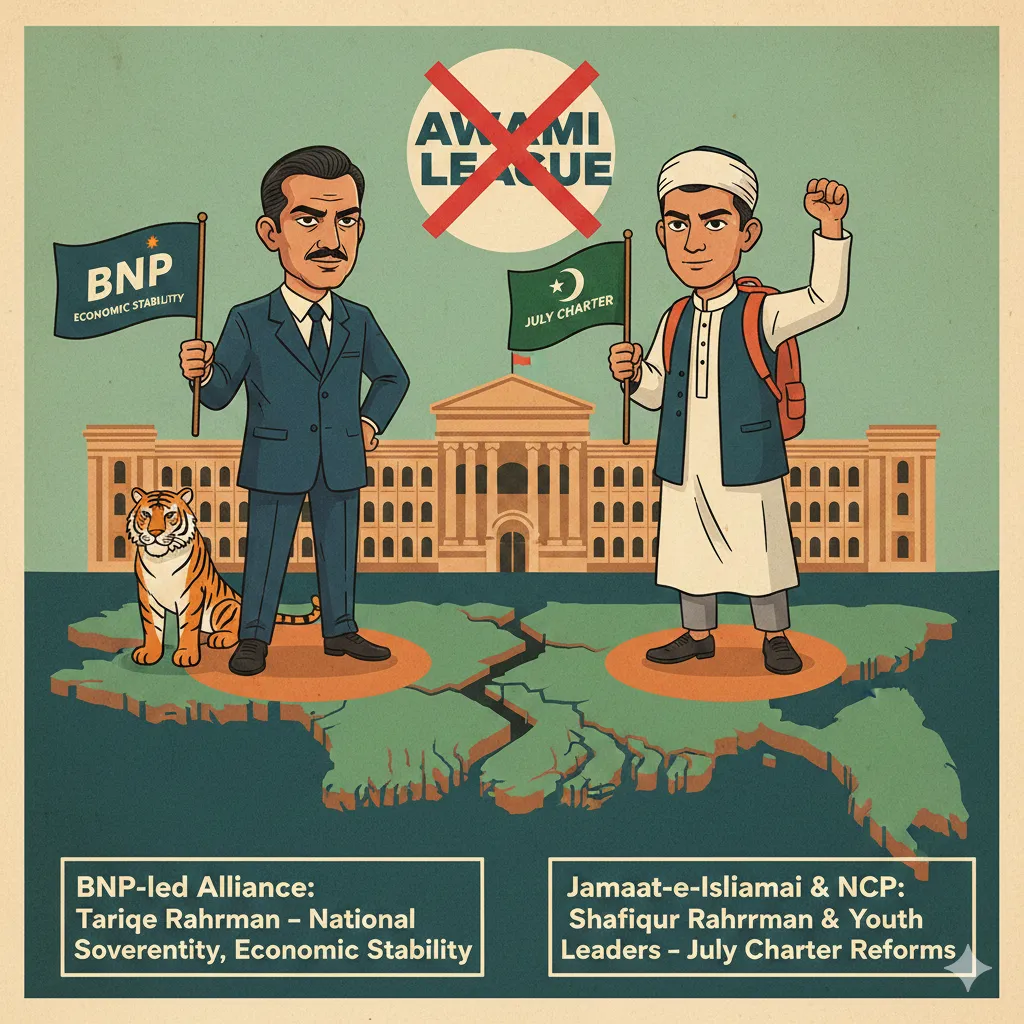
The National Citizen Party (NCP), formed by the leaders of the 2024 student movement, has entered a strategic alliance with Jamaat-e-Islami, creating a formidable “third force” that appeals to both religious conservatives and revolutionary youth.
What the World is Watching
The outcome of the Bangladesh General Elections will reverberate beyond its borders. Regional powers like India and China are observing closely to see how the next government will balance its foreign policy.
Furthermore, the simultaneous Constitutional Referendum on the “July Charter” will determine if Bangladesh moves toward a more balanced parliamentary system, limiting the powers of the Prime Minister to prevent future authoritarianism.
”This is the world’s first ‘Gen Z-inspired’ election. It will determine if the energy of the 2024 streets can be successfully translated into the stability of the 2026 parliament.” — Political Analyst.
Conclusion
As the polls close this evening, Bangladeshis await a result that could redefine their nation for decades. Whether Tarique Rahman leads the BNP back to power or the youth-led alliances secure a seat at the table, the message from the voters is clear: they want a democracy that is as resilient as the movement that brought them to this day.