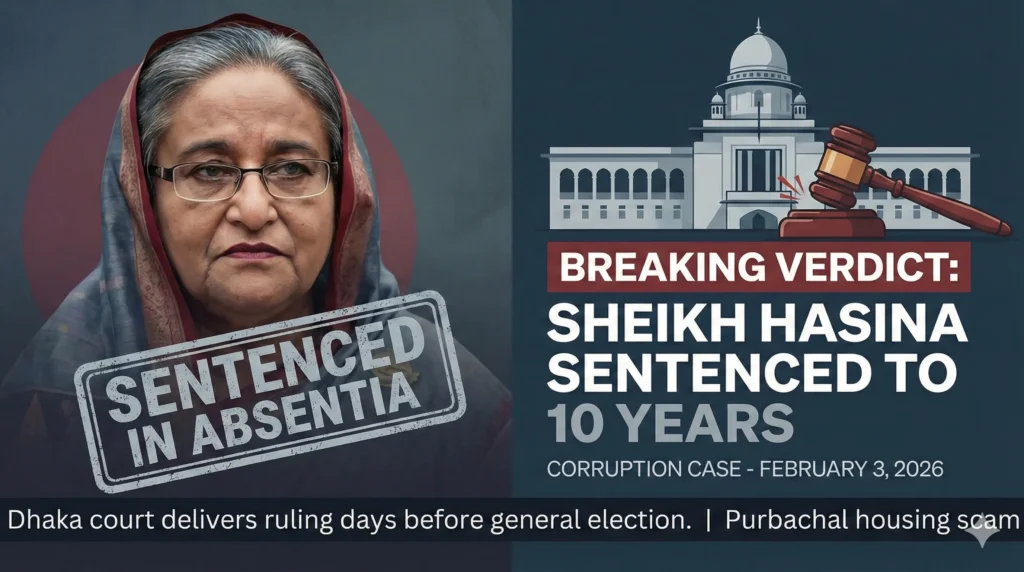
The political landscape of Bangladesh faced another seismic shift yesterday as a Dhaka court sentenced former Prime Minister Sheikh Hasina Sentenced to 10 Years in Prison in relation to corruption cases. This verdict, delivered on February 2, 2026, marks a significant development in the post-ouster legal proceedings against the former leader, who has been living in exile in India since August 2024.
With the country just days away from its critical February 12 general elections, this ruling adds a new layer of complexity to an already volatile political environment. Below, we break down the verdict, the charges, and what this means for the future of Bangladesh.
The Breaking Verdict: 10 Years for Corruption
On Monday, the Dhaka Special Judge’s Court-4 handed down a rigorous 10-year prison sentence to Sheikh Hasina. The verdict was delivered in absentia, as the former premier remains in New Delhi.
The court found Hasina guilty of abusing her power to irregularly allocate state-owned land during her tenure. Specifically, the charges relate to the Rajuk New Town Project in Purbachal, a government housing scheme where plots were allegedly distributed to family members and political allies in violation of state laws.
Key Details of the Sentence:
- Defendant: Sheikh Hasina (Former PM)
- Total Sentence: 10 Years (5 years each for two separate cases).
- Charges: Criminal misconduct and corruption in land allocation.
- Status: Convicted in absentia (currently in exile).
Note: This sentence is separate from the death penalty handed down to Hasina in November 2025 by the International Crimes Tribunal (ICT) for crimes against humanity.
Family Members Also Convicted
The corruption probe did not stop at the former Prime Minister. The court also convicted several of her close relatives, further dismantling the political legacy of the Sheikh family.
Among those sentenced was Tulip Siddiq, Hasina’s niece and a well-known British Member of Parliament. The inclusion of a sitting UK lawmaker in the conviction list has sparked international headlines.
The Co-Accused and Their Sentences:
- Tulip Siddiq (Niece): Sentenced to 4 years in prison.
- Radwan Mujib Siddiq (Nephew): Sentenced to 7 years in prison.
- Azmina Siddiq (Niece): Sentenced to 7 years in prison.
The court also imposed fines on the convicts, ordering additional jail time if the payments are not made. The Awami League, Hasina’s now-banned political party, has dismissed these verdicts as “politically motivated fabrications” orchestrated by the interim government.
The Purbachal Housing Scam Explained
To understand the gravity of this verdict, one must look at the Purbachal New Town Project. This massive urban development initiative on the outskirts of Dhaka was designed to ease the housing crisis in the capital.
However, investigators from the Anti-Corruption Commission (ACC) presented evidence that high-value plots were systematically handed over to the Prime Minister’s inner circle, bypassing the public lottery system and eligibility rules.
Why This Matters for SEO and Public Interest
The term “Purbachal scam” has become a keyword for government graft in Bangladesh. For the average citizen, this case symbolizes the unchecked nepotism that allegedly plagued the latter years of Hasina’s 15-year rule. The court’s decision to pursue this specific case sends a message that financial crimes are being prioritized alongside human rights violations.
A History of Legal Troubles: From Ouster to Exile
Sheikh Hasina’s fall from grace has been rapid and dramatic. Her government collapsed on August 5, 2024, following weeks of student-led protests that spiraled into a nationwide uprising. The crackdown on these protests resulted in an estimated 1,400 deaths, a tragedy that continues to haunt the nation.
Since fleeing to India, Hasina has faced a barrage of legal actions:
- August 2024: Ouster and flight to India.
- October 2024: Arrest warrants issued by the International Crimes Tribunal.
- November 17, 2025: Sentenced to death for crimes against humanity (mass killings during the 2024 uprising).
- February 2, 2026: Sentenced to 10 years for corruption.
This cumulative legal weight makes her potential return to Bangladesh increasingly unlikely, despite her repeated assertions of innocence.
The Interim Government & The ‘New Bangladesh’
The verdict comes at a pivotal moment. The Interim Government, led by Nobel Laureate Dr. Muhammad Yunus, is preparing to hold the first general election since the uprising. Scheduled for February 12, 2026, these polls are viewed as a litmus test for the country’s democratic restoration.
Impact on the Upcoming Election
- Awami League’s Absence: With its leadership convicted and the party banned from participating, the election field has shifted dramatically.
- Voter Sentiment: The timing of the verdict—just 10 days before the polls—likely serves to remind voters of the previous regime’s alleged misdeeds, potentially consolidating support for the reformist agenda.
- Security Concerns: Security has been tightened across Dhaka as authorities anticipate potential unrest from Hasina loyalists.
International Diplomatic Tensions
The sentencing of Sheikh Hasina places India in a difficult diplomatic position. New Delhi has provided her with a “safe house” and security since her arrival in 2024, citing historical ties and humanitarian grounds.
However, with multiple convictions now on record—including a death sentence and a corruption verdict—Dhaka’s extradition requests are becoming harder to ignore.
- Dhaka’s Stance: The Yunus administration demands her return to face justice.
- New Delhi’s Stance: India has remained tight-lipped, but experts suggest the asylum is becoming a major friction point in bilateral relations.
- UK’s Dilemma: With Tulip Siddiq now a convicted felon in Bangladesh, the UK government faces its own diplomatic headache regarding its MP.
Conclusion: A Message of Accountability
The 10-year prison sentence for Sheikh Hasina is more than just a legal ruling; it is a political statement. It signals that the Interim Government is determined to close the chapter on the previous regime before the new elected government takes power later this month.
As Bangladesh heads to the polls on February 12, the shadow of Sheikh Hasina looms large, not as a candidate, but as a cautionary tale of power and its consequences. The world will be watching to see if this verdict helps heal the nation’s wounds or deepens its divides.
Frequently Asked Questions (FAQ)
Q: Why was Sheikh Hasina sentenced to prison?
A: She was sentenced to 10 years in prison on February 2, 2026, for corruption related to the illegal allocation of land in the Purbachal housing project.
Q: Is Sheikh Hasina currently in jail?
A: No. Her party has been banned, and her criminal convictions disqualify her from holding office.
Q: What about her death sentence?
A: In November 2025, she was sentenced to death for crimes against humanity regarding the 2024 protest crackdown. The new 10-year sentence is an additional conviction for separate financial crimes.