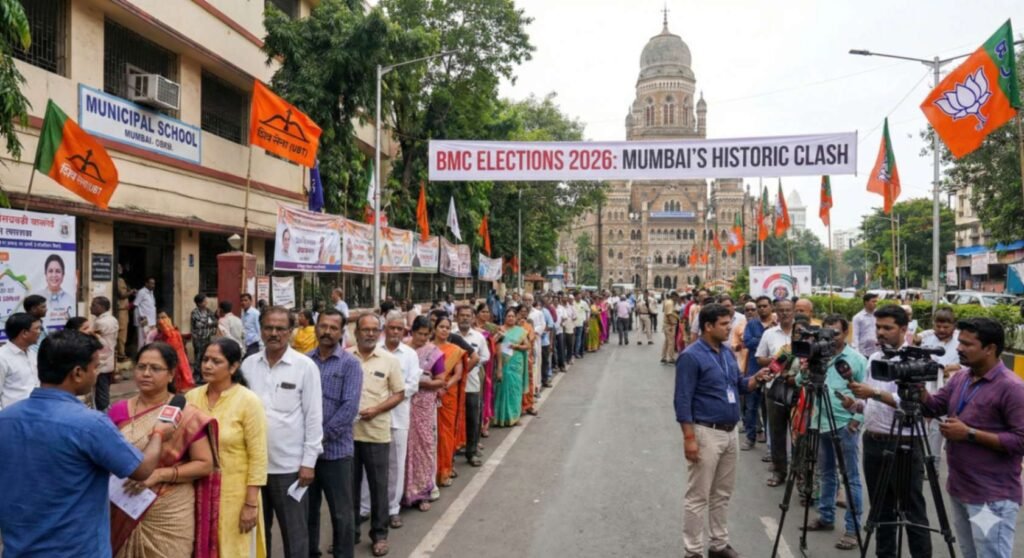
BMC Elections 2026. The atmosphere across Mumbai is electric today as millions of Mumbaikars queue up to cast their votes in what is being described as the most significant Brihanmumbai Municipal Corporation election in decades. The political landscape of Maharashtra has shifted dramatically with the voting process now fully underway across all two hundred and twenty-seven municipal wards. This election is not merely about civic amenities but has evolved into a battle for the very soul of Mumbai, pitting the combined might of the Bharatiya Janata Party and Eknath Shinde’s Shiv Sena against the formidable and emotionally charged reunion of Uddhav and Raj Thackeray. The long-awaited polls are witnessing a massive voter turnout as citizens step out to decide who will control Asia’s richest civic body after years of administrative rule.
The Thackeray Reunion: A Game Changer for Marathi Asmita
The most defining narrative of the 2026 BMC polls is undoubtedly the historic alliance between estranged cousins Uddhav Thackeray and Raj Thackeray. After two decades of political separation, their decision to join forces has galvanized the traditional Marathi vote bank which had felt fragmented in recent years. This strategic consolidation aims to reclaim the Shiv Sena’s original bastion by appealing to “Marathi Asmita” or Marathi pride, a sentiment that has always been the cornerstone of local politics in the financial capital. Political analysts suggest that this reunion has injected a renewed sense of aggression and purpose into the opposition campaign, making what initially looked like a comfortable edge for the ruling Mahayuti alliance into a neck-and-neck contest for supremacy over Mumbai.
Mahayuti’s Pitch: Development and Double-Engine Governance
On the other side of the spectrum, the ruling Mahayuti alliance led by the BJP and Chief Minister Eknath Shinde is banking heavily on their track record of massive infrastructure projects. Their campaign has focused relentlessly on the transformation of Mumbai through the expansion of the Metro network, the Coastal Road project, and the promise of a slum-free city through ambitious redevelopment schemes like Dharavi. The ruling coalition argues that a “double-engine” government—having the same alliance in power at the state and civic levels—is essential for the seamless funding and execution of these mega-projects. They have countered the emotional appeal of the Thackerays with a narrative of stability, modernization, and a global vision for Mumbai that goes beyond regional identity politics.
Critical Issues Driving the High Voter Turnout
Beyond the clash of political titans, the common Mumbaikar is voting today with pressing civic issues in mind. The delay in elections has led to accumulated grievances regarding pothole-ridden roads, water logging, and the city’s deteriorating air quality which has become a major health concern. Voters are demanding accountability for the civic administration’s performance over the last few years during which the corporation was run by administrators without elected representatives. Issues such as the redevelopment of dilapidated chawls, rising property taxes, and the preservation of open spaces are dominating conversations outside polling booths. The high turnout indicates a restless electorate eager to reinstall a democratic council that can be held answerable for the daily hardships faced by the city’s residents.
The Final Verdict Awaits
As polling stations prepare to close later this evening, the tension remains palpable across strongholds of both alliances. The stakes are incredibly high because controlling the BMC is often seen as a gateway to controlling Maharashtra politics. For the BJP and Eknath Shinde, a win would cement their legitimacy and dominance over the city. For the reunited Thackeray cousins, this election is an existential fight to prove that the legacy of Balasaheb Thackeray still commands the loyalty of Mumbai. The results of this high-voltage drama will shape the future trajectory of urban governance in India’s financial powerhouse for the next five years.