Table of Contents
- The 75-Year Tradition: What Usually Happens?
- The New ‘Part B’: A Vision for 2047
- Why This Shift Matters for the Economy
- Key Expectations: Beyond Income Tax
- Conclusion: A New Era of Budgeting
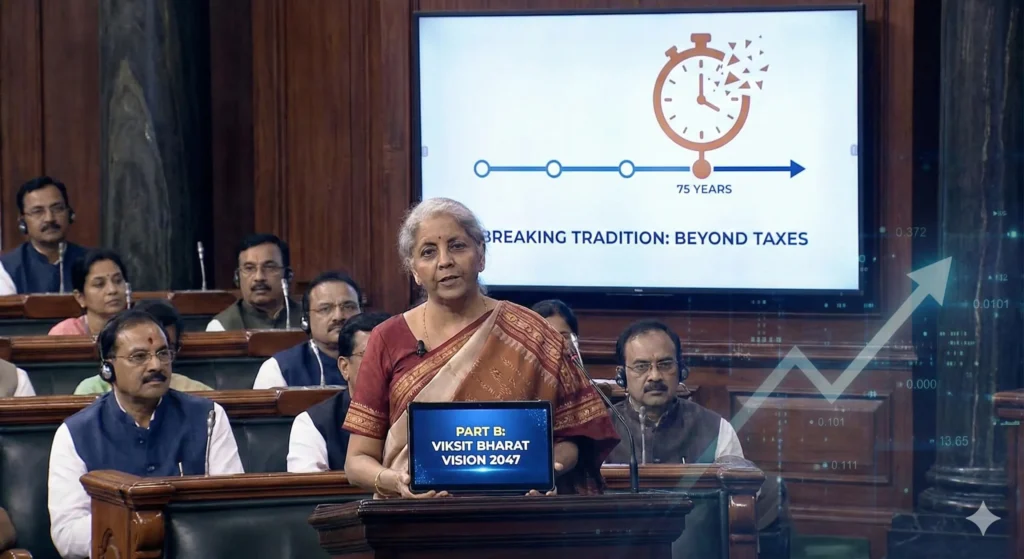
Breaking Tradition: Finance Minister Nirmala Sitharaman is expected to rewrite the rulebook during her Budget speech today. As the nation tunes in to watch the Union Budget 2026, reports suggest a significant departure from convention that could redefine how India plans its economic future.
For over seven decades, the “Part B” of the Budget speech has been synonymous with one thing: Taxes. However, today’s speech is poised to break a 75-year tradition. Instead of being limited to direct and indirect tax proposals, Part B is expected to unveil a comprehensive, long-term vision for India’s economic roadmap.
This strategic pivot is not just a change in format; it is a statement of intent. As India marches towards becoming a developed nation by 2047 (Viksit Bharat), the Finance Minister is prioritizing structural reforms over incremental tax tweaks.
The 75-Year Tradition: What Usually Happens?
To understand the magnitude of this shift, we must look at the history of the Union Budget. Traditionally, the Finance Minister’s speech is divided into two distinct sections:
- Part A: This section deals with the macro-economic outlook, broad policy announcements, and scheme allocations. It paints the “big picture” of the government’s spending plan.
- Part B: This is the section most taxpayers wait for with bated breath. It historically contains the fine print—income tax slab changes, customs duties, and GST-related announcements.
For 75 years, Part B has been technical, dense, and focused on revenue calculations. It was rarely the platform for grand visionary statements. Breaking tradition, FM Nirmala Sitharaman is expected to transform this technical section into a policy powerhouse today.
The New ‘Part B’: A Vision for 2047
Why the change? The government aims to signal that India’s economic trajectory is no longer just about balancing books; it is about setting a global agenda.
Sources indicate that the reimagined Part B will focus on:
- Long-Term Goals: A clear roadmap for the next 5–10 years rather than just the upcoming fiscal year.
- Structural Reforms: Deep-diving into “Next Generation Reforms” that go beyond simple taxation.
- Global Positioning: Strategies to establish India as a manufacturing hub and a leader in the digital economy.
By using Part B to discuss these themes, the Finance Minister is effectively saying that tax policy is a tool for growth, not just revenue collection. This aligns with the “Reform Express” agenda, suggesting that the government is confident enough to look beyond short-term populist measures.
Note: This move mirrors the confidence of a government looking at a multi-decade horizon, focusing on the Amrit Kaal period leading up to the centenary of India’s independence.
Why This Shift Matters for the Economy
You might ask, “Why should I care if the speech structure changes?” The answer lies in market sentiment and investor confidence.
When a Finance Minister uses the “business end” of the speech to talk about vision, it tells global investors that the policy environment will be stable and predictable. It moves the conversation from “How much tax will I pay this year?” to “Where is the country heading in the next decade?”
1. Signal of Stability
A vision-oriented Part B suggests that the government has moved past the need for frequent, volatile tax changes. It implies a stable tax regime where rates don’t fluctuate wildly every year.
2. Focus on Manufacturing & Exports
Expectations are high that Part B will outline a Unified Export and Manufacturing Zone. By merging schemes like SEZs (Special Economic Zones) and EOUs (Export Oriented Units), the government hopes to streamline operations for businesses, making “Make in India” more than just a slogan.
Key Expectations: Beyond Income Tax
While the spotlight is on the structural shift, the “Breaking Tradition” narrative also hints at what will be announced.
Customs Duty Overhaul
Part B is expected to propose a massive rationalization of customs duties. The goal? To simplify trade, reduce disputes, and integrate India more deeply into the global supply chain. This is a direct move to counter global economic slowdowns and tariff wars.
The ‘Reform Express’
Insiders are calling this budget the “Reform Express.” We expect announcements related to:
- Land and Labor Reforms: Crucial for industrial growth.
- Ease of Doing Business: Reducing compliance burdens for MSMEs.
- Green Energy Transition: Incentives for renewable energy adoption.
While the common man will still look for tax relief (possibly in the form of standard deduction hikes), the emphasis of the speech will clearly be on these broader economic pillars.
Conclusion: A New Era of Budgeting
As Finance Minister Nirmala Sitharaman stands up to present her ninth consecutive budget, she is doing more than just reading a financial statement. By breaking the 75-year tradition of a tax-heavy Part B, she is setting a new precedent.
This budget is likely to be remembered not for a specific tax cut, but for shifting the nation’s focus from “annual survival” to “generational growth.” For investors, taxpayers, and policy watchers, the message is clear: The Indian economy is shifting gears, and the budget speech is evolving to match that pace.
Frequently Asked Questions (FAQs)
Q: What is the “Part B” of the Budget speech?
A: Part B traditionally contains detailed proposals regarding direct and indirect taxes. It is the section where income tax slab changes are usually announced.
Q: How is Nirmala Sitharaman breaking tradition in 2026?
A: She is expected to use Part B to outline a detailed long-term economic vision and structural reforms, rather than limiting it to just tax proposals.
Q: When is the Budget 2026 being presented?
A: The Union Budget 2026 is being presented today, February 1, 2026.