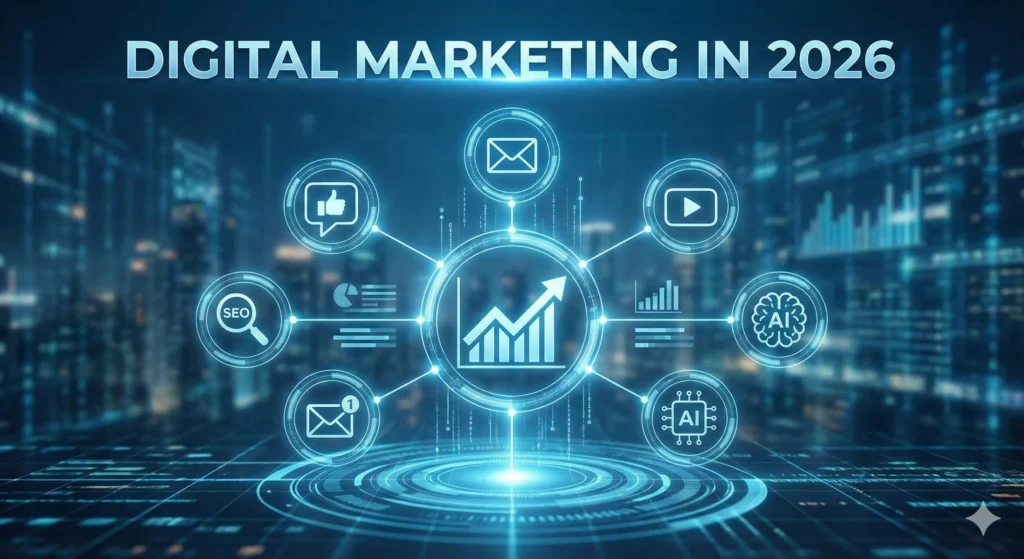
Are you struggling to grow your business in today’s crowded online world? You are not alone. Digital marketing is no longer just an option; it is the engine that drives modern business growth.
In 2026, the landscape is evolving faster than ever. With the rise of AI agents, voice search, and hyper-personalization, old strategies simply don’t work anymore. If you want to capture attention and convert leads, you need a modern approach.
In this comprehensive guide, we will break down exactly what digital marketing is, the top trends you need to know for 2026, and how you can build a strategy that actually drives revenue.
What is Digital Marketing?
At its core, digital marketing encompasses all marketing efforts that use an electronic device or the internet. Businesses leverage digital channels such as search engines, social media, email, and other websites to connect with current and prospective customers.
Unlike traditional marketing—which relies on print ads, billboards, or TV commercials—digital marketing allows for two-way communication. It is data-driven, measurable, and often more cost-effective.
Why is it Critical in 2026?
The modern consumer is “online-first.” Whether they are looking for a local plumber or a global software solution, their journey begins with a search engine or a social media feed. If your brand isn’t there, you don’t exist.
Key Channels of Digital Marketing
To build a robust online presence, you cannot rely on just one platform. You need a mix of the following channels:
1. Search Engine Optimization (SEO)
SEO is the art of optimizing your website to rank higher in search engine results pages (SERPs). When people search for “best running shoes” or “how to build a website,” you want your site to appear at the top.
- On-Page SEO: Optimizing content, keywords, and HTML tags.
- Off-Page SEO: Building backlinks and domain authority.
- Technical SEO: Improving site speed and mobile-friendliness.
2. Content Marketing
”Content is King” is still true, but context is Queen. This involves creating valuable, relevant content—like blog posts, videos, and infographics—to attract an audience. The goal is to build trust so that when the customer is ready to buy, they choose you.
3. Social Media Marketing
This involves promoting your content and engaging with your audience on social media channels like Facebook, Instagram, LinkedIn, and X (formerly Twitter). In 2026, short-form video (like Reels and TikToks) is the dominant format here.
4. Email Marketing
Despite the rise of social media, email remains one of the highest ROI channels. It allows you to nurture leads with personalized messages, product updates, and newsletters directly in their inbox.
Top 5 Digital Marketing Trends for 2026
If you want to stay ahead of the curve, you must adapt to these shifting trends:
- AI Agents & Automation: It is no longer just about Chatbots. AI agents now handle complex customer service queries and even perform tasks like booking appointments without human intervention.
- Voice & Conversational Search: With smart speakers and mobile assistants, people are searching using natural language. Your digital marketing strategy must optimize for questions like “What is the best pizza place near me?” rather than just keywords.
- Privacy-First Marketing: With third-party cookies disappearing, owning your data (First-Party Data) is crucial. Building your own email list is more important than ever.
- Video-First Content: Text is good, but video is better. Platforms are prioritizing video content in algorithms, making it essential for engagement.
- Hyper-Personalization: Generic mass emails are dead. AI tools now allow you to send highly personalized messages based on specific user behaviors.
Benefits of Digital Marketing for Your Business
Why should you invest your time and budget here?
- Global Reach: You can trade with anyone, anywhere in the world.
- Lower Cost: A proper digital strategy is often cheaper than traditional advertising.
- Traceable Results: You can track every click, view, and sale using analytics tools.
- Improved Conversion Rates: By targeting specific demographics, you send traffic that is more likely to convert.
How to Build a Winning Strategy
Success doesn’t happen by accident. Follow these steps to build your digital marketing plan:
- Define Your Goals: Do you want more traffic, more leads, or more brand awareness?
- Identify Your Audience: Who are they? Where do they hang out online?
- Choose Your Channels: Don’t try to be everywhere. Pick the channels where your audience is most active.
- Create Great Content: Solve your audience’s problems with high-quality content.
- Measure and Optimize: Use tools like Google Analytics to see what’s working and fix what isn’t.
Conclusion
Digital marketing is a vast and ever-changing field, but the fundamentals remain the same: connect with your audience at the right time and in the right place. By leveraging SEO, content, and the latest AI trends of 2026, you can future-proof your business and drive sustainable growth.
Frequently Asked Questions (FAQ)
1. Can I do digital marketing myself?
Yes! Many tools like WordPress, Canva, and Google Analytics are free and user-friendly. However, as your business grows, hiring an expert can save time and improve results.
2. Which channel is best for digital marketing?
It depends on your business. B2B businesses often thrive on LinkedIn and SEO, while B2C fashion brands might find more success on Instagram and TikTok.
3. How much does digital marketing cost?
It can be free (organic social media and SEO) or cost thousands per month (PPC ads). The beauty of digital marketing is that it scales with your budget.