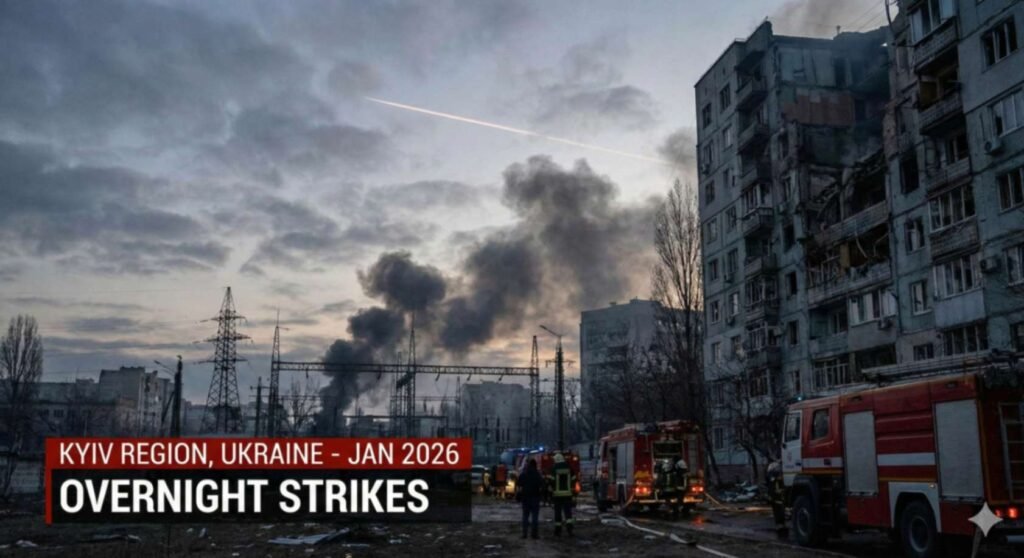
Escalation in Eastern Europe: Russia Unleashes Massive Overnight Aerial Offensive on Ukraine. The conflict in Eastern Europe has taken a severe turn as Russia launched one of its most intense large-scale missile and drone strikes across Ukraine overnight. This latest wave of aerial bombardment targeted multiple regions, including the capital city of Kyiv, marking a significant escalation in the nearly four-year-long war. Reports from the ground indicate that critical energy infrastructure and residential areas bore the brunt of the assault, leaving thousands without power and resulting in civilian casualties. The skies over major Ukrainian cities were illuminated by air defense systems intercepting incoming threats, yet the sheer volume of the attack overwhelmed local defenses in several sectors. This aggressive move by Moscow signals a renewed push to destabilize Ukraine’s internal grid during the critical winter months, aiming to break the resilience of the population through relentless psychological and physical pressure.Military analysts suggest that this overnight offensive involved a sophisticated mix of weaponry, including advanced cruise missiles and new variants of attack drones. The coordination of these strikes demonstrates Russia’s evolving tactics, utilizing swarm drone attacks to distract air defense batteries while precision missiles target strategic facilities. The international community has swiftly condemned the barrage, with European leaders calling it a blatant violation of humanitarian laws. As rescue teams work tirelessly to pull survivors from the rubble and engineers race to restore electricity to blacked-out neighborhoods, the situation remains fluid and highly volatile. This escalation not only deepens the humanitarian crisis but also complicates ongoing diplomatic efforts to find a ceasefire, proving that the path to peace remains fraught with danger and uncertainty.
The Scope of the Offensive: Missiles, Drones, and Decoys
According to the Ukrainian Air Force and military analysts, the barrage involved a terrifying combination of over 425 projectiles. The strike package was meticulously designed to saturate Ukrainian airspace, using a mix of:
- Geran-3 and Shahed-type drones: Used primarily as “swarm” units to drain air defense ammunition.
- Iskander-M Ballistic Missiles: High-speed projectiles aimed at hardened command centers and substations.
- Zirkon Hypersonic Missiles: Deployed against high-value targets in Kyiv to test reaction times.
- Oreshnik Intermediate-Range Missiles: Reported strikes in western Ukraine, signaling a warning to NATO allies bordering the conflict.
The sheer volume of this escalation in Eastern Europe indicates a strategic shift. Moscow is no longer just targeting the frontline; it is attempting to dismantle the civilian “rear” to break the national will before any potential spring negotiations.
In cities like Kharkiv and Sumy, where temperatures are currently hovering around -10°C, the loss of heating is not just an inconvenience—it is a life-threatening crisis. Ukrainian Energy Minister Mykhailo Fedorov noted that the “cumulative degradation” of the grid has reached a tipping point, making repairs increasingly difficult as spare parts run low.
The Humanitarian Toll: Civilians Under Fire
While Russia claims to target only military and strategic assets, the reality on the ground paints a different picture. Residential apartment blocks in Kramatorsk and Odesa were struck during the night.
”Moscow only understands the language of pressure. They are deliberately leaving children without heat in freezing frosts to gain leverage at the negotiating table,” stated Ukrainian Foreign Minister Andrii Sybiha.
The UN has reported that over 10.8 million people in Ukraine now require urgent humanitarian assistance. This escalation in Eastern Europe is expected to trigger a new wave of internal displacement, as families flee darkened cities for rural areas or cross into neighboring Poland and Romania.
Geopolitical Repercussions: NATO and the West
This escalation in Eastern Europe has reverberated far beyond the borders of Ukraine. For the first time, NATO forces were forced into an “active defensive posture” as Russian drones violated Polish airspace during the strikes.
- Poland’s Response: Warsaw has requested urgent consultations under NATO’s Article 4, following the interception of a stray drone by Polish F-16s.
- UK Interceptor Drones: The United Kingdom has fast-tracked the delivery of advanced interceptor drones, specifically designed to hunt the “Shahed” variants at a lower cost than traditional missiles.
- The Geneva Talks: The prospect of a ceasefire in 2026 now looks increasingly grim. Analysts suggest that the Kremlin is using this escalation in Eastern Europe to maximize its territorial “facts on the ground” before any formal borders are drawn by international pressure.
Why This Escalation Matters Now
We are entering the “Moment of Truth” for 2026. The conflict is currently in a “limbo” between a war of attrition and a quest for a permanent peace deal. However, the intensity of the latest strikes suggests that Russia believes it can still outlast Western resolve.
By targeting energy infrastructure, Russia aims to:
- Force a Refugee Crisis: Putting pressure on EU social systems.
- Halt Industry: Stopping the domestic production of Ukrainian weaponry.
- Psychological Warfare: Keeping the population in a state of constant survival mode.
Conclusion: A Region on the Brink
The escalation in Eastern Europe seen tonight is a stark reminder that the war is far from over. As the fourth anniversary of the invasion approaches, the conflict has entered a more dangerous, high-tech phase. The international community’s response in the coming days—whether through increased air defense shipments or secondary sanctions on the “shadow fleet”—will determine if Ukraine can survive the remaining months of winter.
The “aerial offensive” is more than just a military tactic; it is a signal that the cost of peace, and the cost of war, is rising for everyone involved.