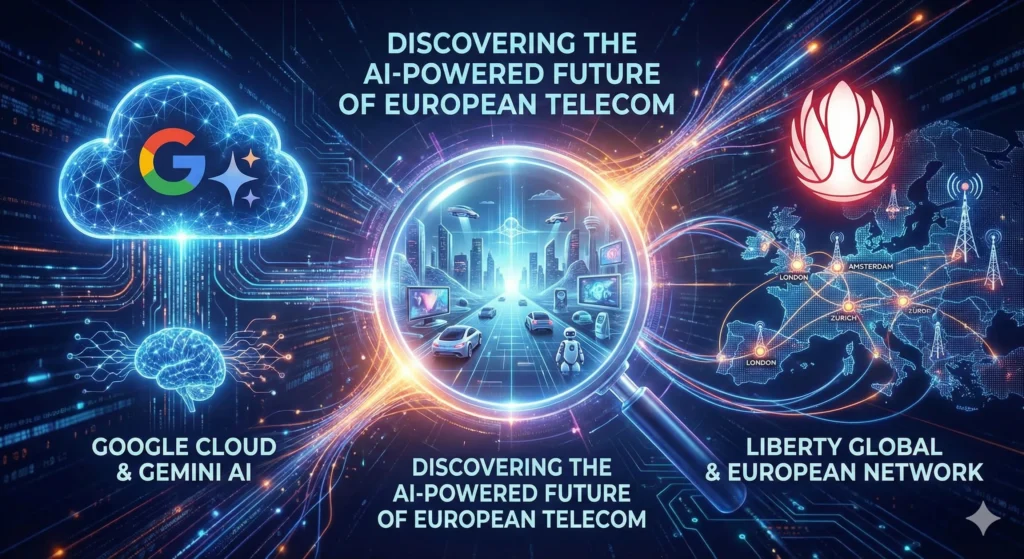
The telecommunications landscape in Europe is on the brink of a major technological evolution. In a landmark move, Liberty Global, one of the world’s leading converged video, broadband, and communications companies, has announced a massive five-year strategic partnership with Google Cloud.
This collaboration is not just a standard cloud migration; it is a fundamental reimagining of how telecom operators interact with their customers and manage their networks. By integrating Google’s cutting-edge Gemini AI models, Liberty Global aims to deliver hyper-personalized entertainment, seamless connectivity, and next-generation customer support to millions of users across Europe.
In this post, we will dissect the Google Cloud Liberty Global deal, explore the role of Generative AI in telecom, and analyze what this means for the future of the industry.
The Strategic Partnership Explained
At its core, this partnership represents a deepening of ties between a telecom giant and a hyperscale cloud provider. Liberty Global creates world-class connectivity products through its operating companies, including household names like Virgin Media O2 in the UK, VodafoneZiggo in the Netherlands, Telenet in Belgium, and Sunrise in Switzerland.
The five-year agreement allows Liberty Global to utilize Google Cloud as its primary cloud provider for data and analytics. However, the headline feature of this deal is the wide-scale deployment of Google’s Gemini AI.
Why Now?
The telecom industry faces increasing pressure to reduce operational costs while simultaneously improving customer satisfaction (CSAT) scores. Traditional legacy systems are often siloed and reactive. By leveraging Google Cloud’s infrastructure, Liberty Global can unify its data, making it accessible for AI models to generate real-time insights.
Key Takeaway: This deal moves Liberty Global from a traditional connectivity provider to an AI-first digital services company.
Powering Telecom with Gemini AI
The star of this partnership is undoubtedly Google’s Gemini. As Google’s most capable and general-purpose AI model, Gemini is designed to understand and operate across different types of information, including text, code, audio, image, and video.
For a telecom operator, this multimodal capability is a game-changer. Here is how Gemini will be deployed across Liberty’s infrastructure:
1. Generative AI for Customer Support
One of the most immediate impacts will be seen in customer service. Traditional chatbots in the telecom sector are often rigid, relying on pre-programmed scripts that frustrate users with complex issues.
With Gemini, Liberty Global can deploy intelligent agents capable of natural language understanding. These AI agents can:
- Diagnose technical issues by reading network logs in real-time.
- Guide customers through troubleshooting steps conversationally, rather than via static FAQs.
- Hand off to human agents seamlessly, providing the agent with a full summary of the problem and suggested fixes.
2. Hyper-Personalized Content Discovery
Liberty Global isn’t just about broadband; it is a massive player in TV and entertainment. The deal involves integrating Google’s AI into Liberty’s “Horizon” entertainment platform.
Instead of scrolling through endless menus, Gemini-powered recommendation engines will analyze viewing habits to suggest content with pinpoint accuracy. Imagine asking your TV, “Find me a sci-fi movie from the 90s that isn’t too dark,” and receiving a curated list instantly.
Revolutionizing Network Management
While customer-facing features grab the headlines, the backend improvements are equally critical. The Google Cloud Liberty Global deal provides the telecom giant with the computational power needed to optimize vast, complex networks.
Predictive Maintenance
Network outages are the bane of any telecom operator. By feeding network performance data into Google Cloud’s analytics suite, AI models can identify patterns that precede a failure.
- Proactive Repair: The system can alert engineers to a degrading signal in a specific neighborhood before the service goes down.
- Traffic Optimization: During high-traffic events (like the Super Bowl or World Cup), AI can dynamically allocate bandwidth to prevent buffering and latency.
The Data Cloud Advantage
Liberty Global will utilize BigQuery, Google’s serverless data warehouse, to consolidate data silos. This democratization of data allows data scientists across Liberty’s different operating companies (OpCos) to share insights. For example, a successful network optimization script developed by Virgin Media O2 in the UK could be rapidly deployed by Sunrise in Switzerland.
Why This Matters for the Telecom Industry
The convergence of Telecom and Big Tech is accelerating. Operators possess the “pipes” (5G and Fiber), while hyperscalers like Google, AWS, and Azure possess the “brains” (AI and Cloud Compute).
This partnership sets a standard for the industry for several reasons:
- Speed to Market: Developing proprietary AI models takes years and billions of dollars. Partnering with Google allows Liberty to leapfrog competitors.
- Cost Efficiency: Cloud-native networks are cheaper to run than on-premise hardware, requiring less energy and physical maintenance.
- Future-Proofing: As 6G looms on the horizon, networks will become too complex for humans to manage manually. AI automation is the only viable path forward.
A Competitive Edge in Europe
Europe is a fiercely competitive telecom market. By locking in this partnership, Liberty Global differentiates itself from competitors who may be slower to adopt Generative AI. The ability to offer a “smarter” network is a powerful marketing tool for retaining subscribers in a high-churn industry.
Key Benefits at a Glance
To summarize the impact of the Google Cloud Liberty Global deal, here are the primary benefits:
- Enhanced Customer Experience: Faster resolutions and smarter interactions using Gemini AI.
- Entertainment Evolution: Deep integration of AI into the Horizon TV platform for better content discovery.
- Operational Agility: Unified data analytics across all European operating companies.
- Network Reliability: Predictive maintenance to stop outages before they happen.
- Innovation Engine: A foundation for building future apps and services on Google Cloud.
Frequently Asked Questions (FAQs)
What is the duration of the Google Cloud Liberty Global deal?
The strategic partnership is signed for a five-year term, focusing on cloud transformation and AI integration.
Will this affect my internet speed?
Indirectly, yes. While the deal focuses on cloud and AI, the resulting network optimizations and predictive maintenance should lead to more stable connections and better bandwidth management.
Which countries are affected?
The deal covers Liberty Global’s European footprint, including operations in the UK (Virgin Media O2), the Netherlands (VodafoneZiggo), Belgium (Telenet), Switzerland (Sunrise), and others.
Conclusion
The Google Cloud & Liberty Global deal is more than just a contract; it is a blueprint for the modern telecom operator. By weaving Google’s Gemini AI into the fabric of its network, Liberty Global is moving beyond simple connectivity to become a provider of intelligent digital experiences.
As we move through the 5-year timeline of this partnership, we can expect to see a shift in how we perceive our internet and TV providers—viewing them less as utilities and more as smart, responsive partners in our digital lives.