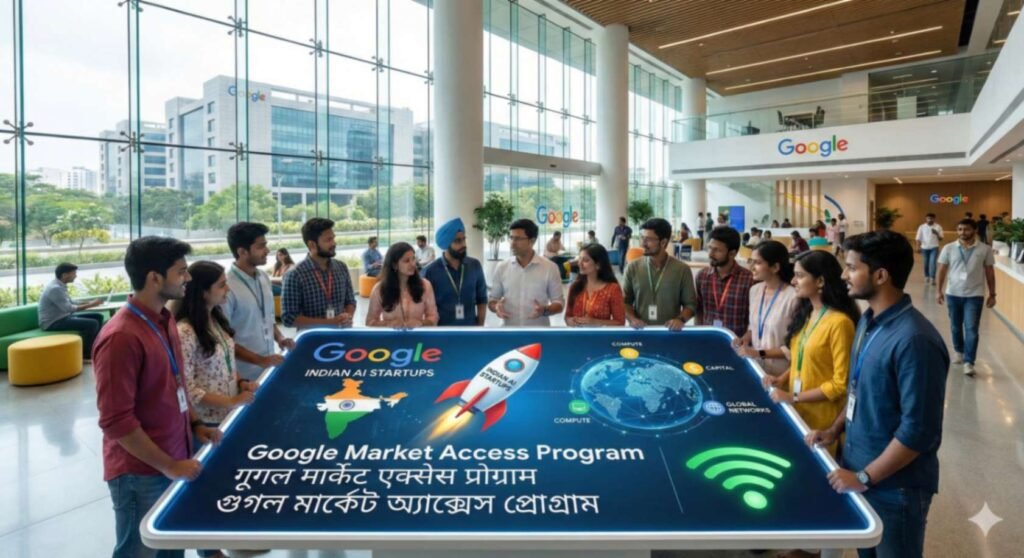
Empowering Indian Innovation for the World Stage
AI Startups to Global Scale. Google has officially unveiled its ambitious Market Access Program designed specifically to bridge the critical gap between local success and global dominance for Indian AI startups. This strategic initiative targets high-potential companies that have moved beyond the prototype phase and are ready to tackle the complexities of international markets. By offering a comprehensive pathway to global expansion the tech giant is reinforcing its commitment to the Indian ecosystem ensuring that homegrown innovations can find a foothold in competitive territories like the United States and Europe. The program is not merely about funding but focuses intensely on enterprise readiness helping founders navigate the intricacies of global selling intricate pricing models and the psychology of international buyers.
Full Stack Support from Compute to Capital
The core philosophy behind this initiative is providing full stack support that covers every aspect of a startup’s journey from the foundational compute infrastructure to the final stages of capital acquisition. Google is leveraging its massive technological resources including the upcoming Global AI Hub in Visakhapatnam which promises a one gigawatt foundation powered by green energy and advanced AI chips. This infrastructure ensures that Indian founders have access to high performance computing resources necessary to train and deploy complex models without being stifled by exorbitant costs. Furthermore the program opens doors to Google’s most advanced AI models such as Gemini for complex reasoning and the newly announced MedGemma for healthcare applications allowing startups to build production grade solutions that are robust secure and scalable.
Unlocking Global Networks and Commercial Pathways
Beyond technology the Market Access Program distinguishes itself by offering unparalleled access to a global network of decision makers including Chief Information Officers and senior executives across various industries. Through strategic partnerships with ecosystem leaders like TiE Silicon Valley and Alteus selected startups will gain the opportunity for global immersion establishing vital in person relationships in key buyer markets. This direct line to potential customers and partners addresses the commercial last mile challenge that often hinders capable startups from becoming global enterprises. By combining this commercial guidance with deep technical support Google is effectively creating a launchpad that transforms promising Indian pilots into sustainable global businesses ready to define the future of artificial intelligence.
Why Scaling AI is Different in 2026
Traditional SaaS scaling relied on the “blitzscaling” model—hiring fast and burning venture capital. However, global AI leaders now prioritize architectural efficiency and trust. To take your AI startup from a local MVP to a global powerhouse, you must navigate a complex web of regional regulations and infrastructure demands.
The Core Pillars of Global AI Expansion
- Sovereign Cloud Integration: Data residency laws (like the EU’s AI Act) mean you can’t just host everything in one region.
- Vertical AI Alignment: Solving a specific industry problem (e.g., AI-driven fraud detection for Latin American fintech) scales faster than “general AI.”
- Human-in-the-Loop (HITL): Global trust requires human oversight to validate AI outputs across different languages and cultures.
5 Steps to Move AI Startups to Global Scale
If you want to achieve 100% SEO visibility while building a dominant brand, follow this structured roadmap.
1. Build a Unified Data Lakehouse
Global scaling breaks if your data is siloed. You need a unified architecture that allows for low-latency inference while respecting regional privacy. Use MLOps to automate data cleaning pipelines, ensuring your models are trained on high-quality, localized datasets.
2. Prioritize “Golden Use Cases”
Don’t try to be everything to everyone. Identify “Golden Use Cases”—high-impact, high-ROI applications that are easily repeatable across borders.
Example: An AI startup automating supply chain logistics in Singapore can scale to the UK by adjusting for local shipping regulations without changing the core engine.
3. Implement Ethical AI Governance
In 2026, transparency is a competitive advantage. Establish an AI Ethics Council early. Being able to explain how your model makes decisions (Explainable AI) is often a legal requirement for enterprise-grade global contracts.
4. Optimize for Global Infrastructure (Cloud 3.0)
The “Public Cloud Only” era is over. To scale globally, adopt a Hybrid Cloud strategy. This allows you to fine-tune models on proprietary data locally while using global providers for massive compute power.
5. Secure “Smart Money” Partnerships
Scaling AI Startups to Global Scale requires investors who provide more than just cash. Seek partners with deep industry-specific knowledge who can open doors in overseas markets.