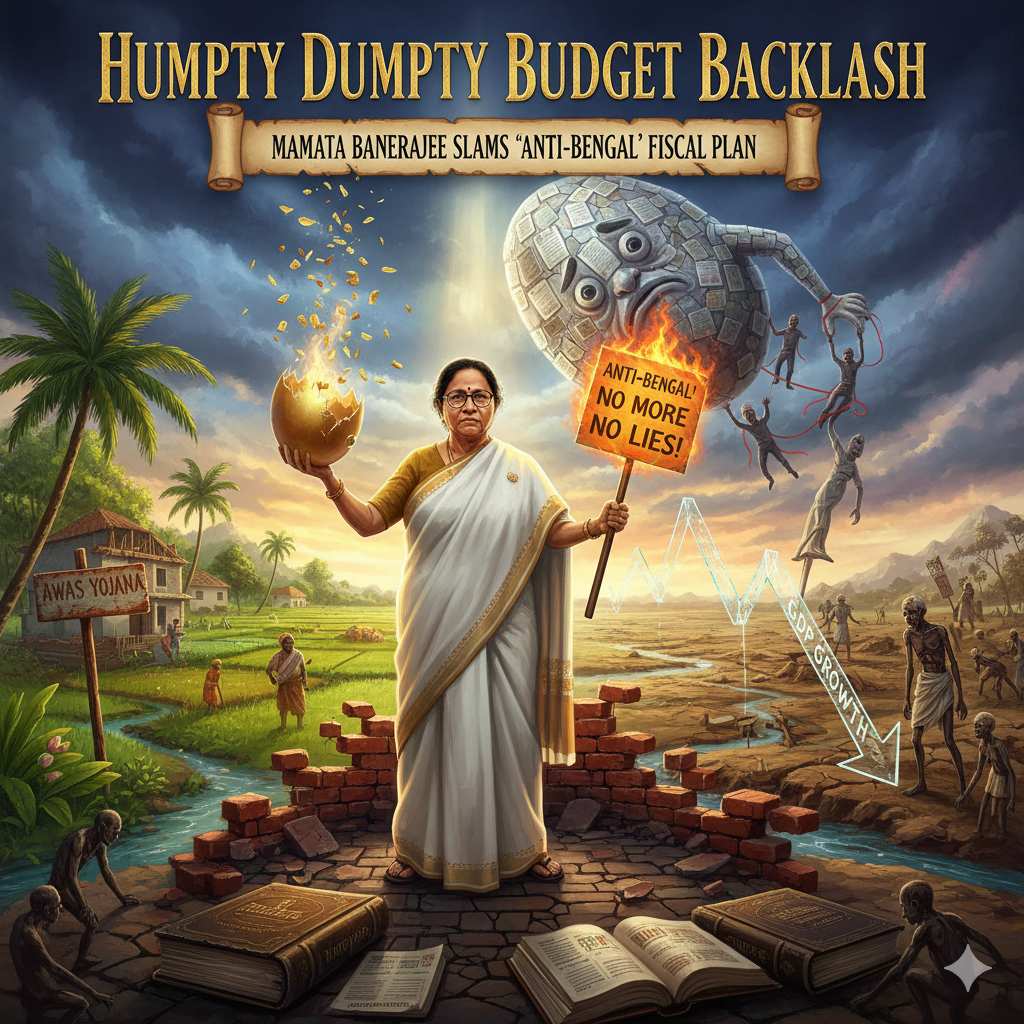
The presentation of the Union Budget 2026-27 has ignited a firestorm in Indian politics, with West Bengal Chief Minister Mamata Banerjee leading the charge. Using her trademark biting wit, the Trinamool Congress (TMC) supremo labeled the fiscal roadmap a “Humpty Dumpty” budget, suggesting it is a fragile structure destined for a great fall.
For Bengal, the rhetoric isn’t just about political posturing; it’s about a deepening fiscal divide. Banerjee has slammed the Center for what she calls a “calculated deprivation” of the state, describing the budget as a mere “jugglery of words” that lacks substance for the common man and the development of West Bengal.
The “Humpty Dumpty” Metaphor: Fragile Promises?
When Mamata Banerjee refers to the budget as “Humpty Dumpty,” she is targeting the perceived instability of the macroeconomic projections. According to the Chief Minister, the Union Budget 2026-27 is built on a foundation of “hollow promises” that will eventually crumble under the weight of rising inflation and unemployment.
Key Criticisms from the CM:
- Lack of Vision: She argues the budget fails to address the “real” India—farmers, laborers, and the middle class.
- Political Bias: Claims that the budget heavily favors states aligned with the ruling NDA coalition while ignoring “opposition-ruled” states like West Bengal.
- Economic Jargon: Banerjee dismissed the complex fiscal targets as “wordplay” designed to confuse the public rather than provide relief.
Why the Label “Anti-Bengal” Matters
The “Anti-Bengal” narrative is not new, but it has reached a fever pitch in 2026. West Bengal has been locked in a long-standing battle with the Central Government over the release of funds for various schemes.
1. The MGNREGA and Awas Yojana Deadlock
A primary point of contention is the continued freezing of funds for the 100 Days of Work (MGNREGA) and the Awas Yojana (housing scheme). Banerjee pointed out that while the Union Budget allocates billions for national infrastructure, Bengal’s poor are being “starved” of their rightful dues due to political vendetta.
2. Infrastructure Gaps
Despite West Bengal being a gateway to the Northeast and Southeast Asia, the CM highlighted that major railway and highway projects in the state received “peanuts” compared to neighboring states. The lack of a specific “Bengal Economic Corridor” in the 2026-27 roadmap was cited as a major snub.
3. Relief for Natural Disasters
Bengal is frequently hit by cyclones and floods. The CM expressed outrage that no special package for Ghatal Master Plan or permanent coastal restoration was mentioned, despite the state’s vulnerability.
”Jugglery of Words”: Analyzing the Fiscal Math
The Chief Minister’s critique of “word jugglery” refers to the way the Union Budget presents its figures. The TMC leadership argues that the fiscal deficit targets and GDP growth projections are overly optimistic and don’t reflect the ground reality of rural distress.
The Political Implications: A Prelude to Future Elections?
The timing of this backlash is crucial. With the political landscape in West Bengal remaining a high-stakes battlefield between the TMC and the BJP, the Union Budget provides the perfect ammunition for the state government to strengthen its “Bengali Pride” (Bangla Nijer Meyekei Chay) narrative.
By framing the budget as a direct attack on the people of Bengal, Mamata Banerjee is effectively:
- Consolidating the Rural Vote: Highlighting the lack of funds for rural employment.
- Challenging the Federal Structure: Raising questions about whether India is still practicing “Cooperative Federalism.”
- National Ambitions: Positioning herself as the primary voice of the opposition against the Center’s economic policies.
Market and Public Reaction
While the stock markets showed a neutral-to-positive response to the Union Budget 2026-27, the “street” sentiment in Bengal remains divided. Economists suggest that while the budget focuses on Capex (Capital Expenditure) to drive long-term growth, it may have missed the mark on immediate consumption-driven relief that states like Bengal desperately need.
”A budget should be for the people, by the people, and of the people. This budget is for the VVIPs, by the VVIPs, and of the VVIPs,” Banerjee stated during her press conference.
Conclusion: A Great Fall or a Steady Climb?
The Union Budget 2026-27 will likely remain a polarizing document. To the Central Government, it is a blueprint for a Viksit Bharat (Developed India). To Mamata Banerjee, it is a “Humpty Dumpty” experiment that ignores the heart of Bengal.
As the fiscal year progresses, the success of this budget will depend on whether the “word jugglery” translates into actual development on the ground. For West Bengal, the battle for “fiscal justice” is far from over, and the Chief Minister has made it clear that she will not take this “slight” lying down.