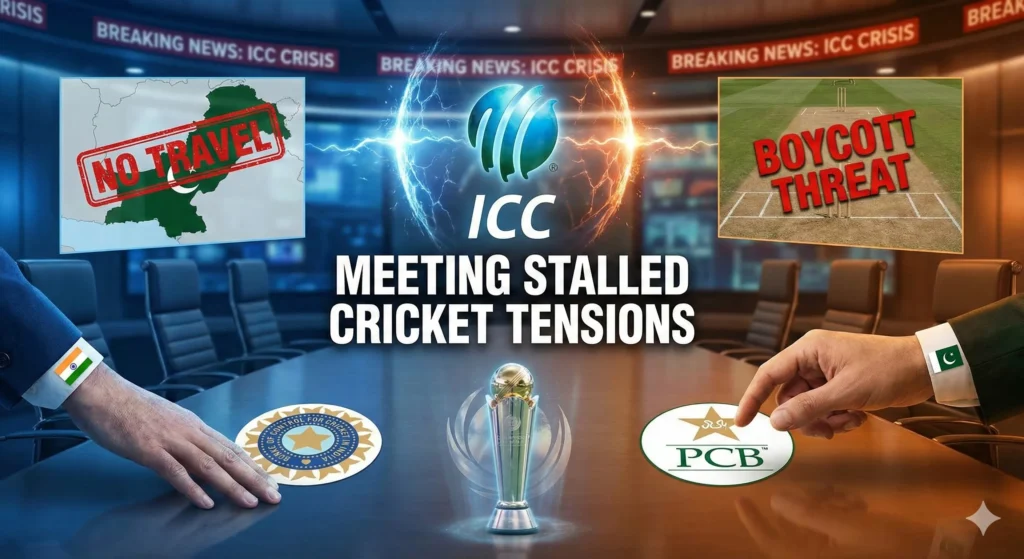
ICC Board Meeting in Limbo Amidst PCB Boycott Threat & India Crisis. The cricketing world is holding its breath. What was supposed to be a routine administrative procedure has spiraled into a full-blown diplomatic standoff. The ICC board meeting is currently in limbo, paralyzed by escalating cricket tensions between two of the sport’s biggest powerhouses: the Board of Control for Cricket in India (BCCI) and the Pakistan Cricket Board (PCB).
With the Champions Trophy 2025 on the horizon, the stakes have never been higher. As the PCB threatens a boycott of playing against India and the BCCI stands firm on security concerns, the International Cricket Council (ICC) faces its toughest diplomatic test in decades. ICC Board Meeting in Limbo Amidst PCB Boycott Threat & India Crisis.
Here is a deep dive into the crisis, the demands, and what this means for the future of global cricket.
Table of Contents
- The Core Issue: Why the ICC Board Meeting is Stalled
- BCCI’s Stance: Security Over Sentiment
- PCB’s Ultimatum: No More Hybrid Models
- The Financial Stakes: A $250 Million Gamble
- ICC in Limbo: Options on the Table
- Conclusion: What Happens Next?
- Frequently Asked Questions (FAQs)
The Core Issue: Why the ICC Board Meeting is Stalled
The heart of the current cricket tensions lies in the venue for the 2025 Champions Trophy. Pakistan is the designated host, marking the first time in decades that the nation is set to host a major ICC global event. However, the celebration has been cut short by geopolitical realities.
The ICC board meeting, which was intended to finalize the schedule and logistics, has been effectively frozen. Reports indicate that the BCCI has formally intimated to the ICC that Team India will not travel to Pakistan due to government denial of permission.
This refusal has triggered a chain reaction. Unlike previous years where compromises were reached quickly, the PCB has dug its heels in, refusing to engage in discussions that strip them of their hosting rights. The meeting cannot proceed constructively until one side blinks, leaving the governance of the sport in a dangerous limbo.
BCCI’s Stance: Security Over Sentiment
For the BCCI, the decision is non-negotiable. The Indian cricket board has consistently maintained that bilateral cricket or travel to Pakistan is subject to approval from the Government of India.
The “No-Go” Policy
The BCCI has cited security concerns and the prevailing political climate as the primary reasons for their refusal. This is not a new stance; India has not toured Pakistan since the 2008 Asia Cup.
- Government Mandate: The BCCI operates under strict instructions from New Delhi regarding cricket with Pakistan.
- Precedent: In 2023, the Asia Cup (hosted by Pakistan) saw India play all their matches in Sri Lanka under a “Hybrid Model.”
The BCCI expects the same “Hybrid Model” to be applied to the Champions Trophy 2025, where India plays their matches in the UAE or Sri Lanka, while the rest of the tournament takes place in Pakistan.
PCB’s Ultimatum: No More Hybrid Models
The Pakistan Cricket Board, led by Chairman Mohsin Naqvi, has taken an unusually aggressive stance this time. Feeling sidelined and disrespected after the 2023 Asia Cup compromise, the PCB is under immense pressure from its own government and public to stand firm.
The Boycott Threat
The most alarming development in these cricket tensions is the PCB’s threat to boycott playing against India in future ICC events if India refuses to visit Pakistan.
- Rejection of Hybrid Model: The PCB has explicitly stated they are not interested in a hybrid solution this time. They want the full tournament in Pakistan or nothing.
- The “Minus India” Formula: In a move that shocked insiders, some PCB officials have suggested they would rather play the tournament without India than accept a diluted hosting role—though this is financially suicidal.
- Future Implications: Reports suggest the PCB might threaten to pull out of the 2026 T20 World Cup (hosted by India and Sri Lanka) or the 2031 World Cup (India) if reciprocity isn’t honored.
Key Quote: “If India does not come to Pakistan, Pakistan will not play against India in any ICC forum.” — Sources close to the PCB.
The Financial Stakes: A $250 Million Gamble
Why is the ICC board meeting so hesitant to make a ruling? The answer is money. The India-Pakistan rivalry is the financial engine of global cricket.
- Broadcaster Rights: ICC media rights values are heavily predicated on the guarantee of at least one India-Pakistan clash per tournament.
- Revenue Loss: An event without India (the largest market) or without an India-Pakistan match could result in losses estimated between $250 million to $500 million for the ICC and its member boards.
If the PCB carries out a boycott, the commercial viability of the Champions Trophy collapses. If the ICC strips Pakistan of hosting rights to appease India, they risk legal action and a fracture in the Asian Cricket Council (ACC).
ICC in Limbo: Options on the Table
The ICC is currently stuck between a rock and a hard place. They cannot force India to travel against government advice, nor can they easily strip Pakistan of hosting rights without severe backlash.
Here are the potential scenarios the board is likely debating behind closed doors:
Scenario A: The Hybrid Model (Most Likely)
The ICC persuades the PCB to accept the Hybrid Model again. India plays in Dubai/Sharjah; the final is in Lahore unless India qualifies, in which case it moves to Dubai. The PCB would likely demand significant financial compensation for this concession.
Scenario B: Relocation (The Nuclear Option)
The entire tournament is moved out of Pakistan to South Africa or the UAE. This would be a diplomatic disaster and would likely lead to the PCB boycotting the event entirely.
Scenario C: Tournament Cancellation
While unlikely, if the stalemate continues, the Champions Trophy itself could be scrapped or postponed, though the crowded cricket calendar makes this difficult.
Conclusion: What Happens Next?
The ICC board meeting cannot remain in limbo forever. With the tournament scheduled for February 2025, a decision must be made within weeks.
The cricket tensions we are witnessing are not just about a single tournament; they are about the power dynamics of modern sport. Will the BCCI’s financial muscle dictate terms, or will the PCB’s principled stance force a change in how global events are managed?
For fans, the hope is simple: that politics can eventually be separated from sport. But as of now, the pitch looks unplayable.
What You Can Do
Stay updated on this developing story. The final decision will set a precedent for the 2026 T20 World Cup and the 2029 Champions Trophy (India).
Frequently Asked Questions (FAQs)
1. Will Pakistan boycott the 2025 Champions Trophy?
It is a possibility. If the ICC moves the tournament entirely out of Pakistan, or if the PCB refuses the Hybrid Model, they have threatened to withdraw.
2. Why is India refusing to travel to Pakistan?
The BCCI has cited security concerns and a lack of clearance from the Indian government due to strained political relations.
3. What is the “Hybrid Model”?
The Hybrid Model allows Pakistan to remain the official host, but India plays their specific matches at a neutral venue (like the UAE), while other teams play in Pakistan.
4. When will the ICC Board Meeting decision be announced?
The meeting is currently stalled. A final decision is expected before the end of the year to allow for logistical planning.