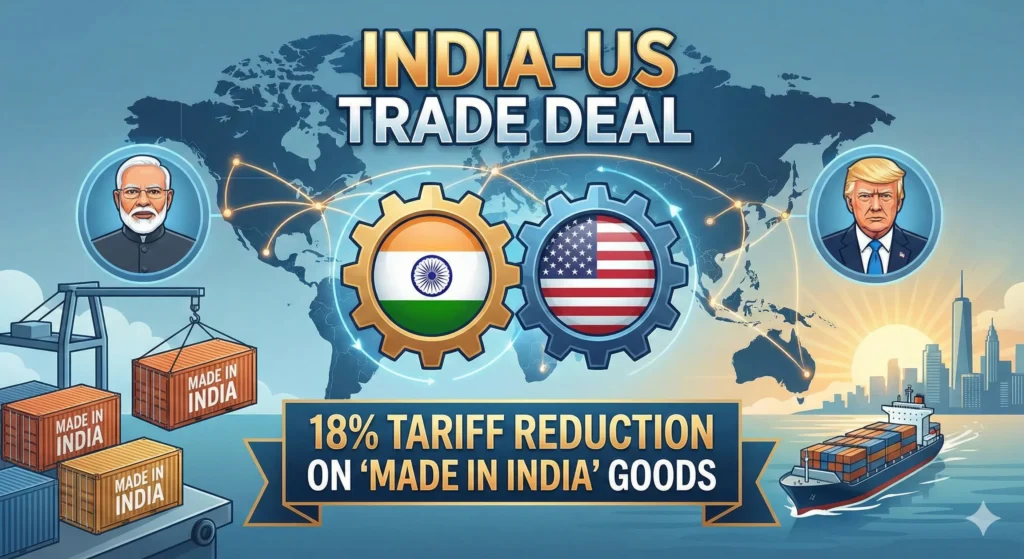
In a geopolitical earthquake that promises to redraw the map of global commerce, Prime Minister Narendra Modi and US President Donald Trump have finalized a historic India-US trade deal. Following a high-stakes, late-night phone call between the two leaders, the United States has officially agreed to a sweeping reduction in tariffs on Indian exports.
The headline announcement is a game-changer: The US will slash reciprocal tariffs on “Made in India” products to a flat 18%. PM Modi has hailed the move as unlocking “immense opportunities” for Indian businesses, signaling the end of a volatile period of trade friction and the beginning of a robust economic alliance.
This 1000-word analysis breaks down exactly what this deal means for the economy, which sectors will boom, and the strategic “China Plus One” implications behind the handshake.
Table of Contents
- The Headline: Breaking Down the 18% Cut
- Background: From Trade Wars to Trade Hugs
- Sector-by-Sector Impact Analysis
- The “China Plus One” Accelerator
- What Did India Give in Return?
- Challenges and The Fine Print
- Conclusion: The Road to $500 Billion
The Headline: Breaking Down the 18% Cut
For the last few years, Indian exporters have navigated a minefield of fluctuating duties. Under the “Reciprocal Trade Act” policies often cited by the Trump administration, tariffs on foreign goods could range anywhere from 25% to 100% if the partner country was perceived as having high barriers.
This new agreement creates a “Safe Harbor” for India. By fixing the tariff rate at 18%, the US has effectively categorized India as a strategic economic partner, distinct from competitors who may still face punitive duties of 60% or higher.
Why 18% Matters:
- Predictability: Businesses hate uncertainty. Knowing the tariff is capped at 18% allows Indian manufacturers to price their goods confidently for long-term contracts.
- Competitiveness: While 18% is not zero duty, it is significantly lower than the rates levied on Chinese goods, giving Indian products a massive price advantage on American shelves.
“Wonderful to speak with my dear friend President Trump today. Delighted that Made in India products will now have a reduced tariff of 18%. Big thanks to President Trump on behalf of the 1.4 billion people of India.”
— Prime Minister Narendra Modi
Background: From Trade Wars to Trade Hugs
To understand the magnitude of this deal, we must look at the history. The India-US trade relationship has often been described as “vast potential, little delivery.”
- The GSP Issue: In previous years, India was removed from the Generalized System of Preferences (GSP), which allowed duty-free entry for thousands of Indian goods. This led to a stalemate.
- The “Tariff King” Claim: President Trump had historically criticized India’s high import duties on American products (like Harley Davidson motorcycles and whiskey), famously calling India a “tariff king.”
The fact that these two leaders have now agreed to an 18% baseline suggests a major diplomatic breakthrough. It indicates that New Delhi likely offered significant concessions on its own import duties, satisfying Washington’s demand for “reciprocity” while securing protection for its own core industries.
Sector-by-Sector Impact Analysis
Who wins the most? The benefits of the India-US trade deal are not evenly distributed. Here is the deep dive into the winners:
1. Textiles & Apparel: The Big Winner
India’s textile industry is the second-largest employer in the country. For years, it struggled against Vietnam and Bangladesh, which enjoyed better tariff rates in Western markets.
- The Shift: With US tariffs on Indian apparel dropping to 18%, major US brands (like Gap, Walmart, and Target) will be incentivized to shift volume from China to hubs in Tirupur and Surat.
- Projected Growth: Industry analysts expect a 20-25% surge in textile exports within the first fiscal year of this deal.
2. Pharmaceuticals: Generic Powerhouse
India supplies nearly 40% of the generic drugs consumed in the US.
- Cost Efficiency: An 18% tariff (down from potential retaliatory highs) ensures that affordable Indian medicines remain the backbone of the US healthcare system.
- R&D Collaboration: The deal is rumored to include “fast-track” FDA inspections for Indian plants, further smoothing the supply chain.
3. Automotive & Engineering
”Made in India” automotive components—gears, shafts, and engine parts—are highly valued by US automakers like Ford and General Motors.
- Supply Chain Integration: Lower tariffs mean US car manufacturers can import high-quality Indian steel and components cheaper, helping them keep their own costs down while reducing reliance on Chinese steel.
The “China Plus One” Accelerator
This trade deal is not just about economics; it is about geopolitics. The United States is actively decoupling from Chinese supply chains. However, you cannot decouple without an alternative destination.
India is that destination.
By lowering the barrier to entry for Indian goods, President Trump is effectively subsidizing the “China Plus One” strategy. He is telling American CEOs: “If you move your factory from Shenzhen to Bengaluru, we will treat your imports favorably.”
This alignment turns India into the “Factory of the Free World,” a role New Delhi has been eager to assume under its Make in India initiative.
What Did India Give in Return?
Diplomacy is a two-way street. While the official “18% cut” is the headline for India, Washington secured its own wins. Based on insider reports and the nature of “reciprocal” deals, India’s concessions likely include:
- Agriculture Access: India may have agreed to lower duties on US apples, almonds, and walnuts—a long-standing demand of American farmers.
- Defense Spending: A commitment to purchase advanced US weaponry, potentially including drones and jet engines, reducing India’s historical reliance on Russian hardware.
- Energy Imports: India is energy-hungry. The deal likely cements India as a top buyer of US Liquefied Natural Gas (LNG) and crude oil, helping narrow the trade deficit that Trump often complains about.
- Digital Trade: Softening of data localization norms to allow US tech giants (Google, Meta, Amazon) to operate more freely in the Indian digital market.
Challenges and The Fine Print
Despite the optimism, experts warn that the devil is in the details.
- Non-Tariff Barriers: Even with an 18% tariff, Indian exporters must still navigate strict US labor and environmental standards.
- Visa Woes: The trade deal notably does not mention H-1B visas. For India’s IT sector, mobility of professionals is as important as the movement of goods. Without a visa component, the services sector might feel left out.
- Implementation Speed: Bureaucracy in both democracies can be slow. How quickly will these tariff cuts appear at the customs checkpoints?
Conclusion: The Road to $500 Billion
The India-US trade deal of 2026 is a watershed moment. It moves the relationship from “strategic partners” to “economic allies.”
For the Indian economy, the 18% tariff cap acts as a turbocharger. It provides the price competitiveness needed to dominate global export markets. For the US, it secures a reliable supply chain partner and a massive market for its energy and defense products.
As PM Modi and President Trump celebrate this victory, the target for bilateral trade is now set firmly at $500 billion. The doors are open, the tariffs are down, and for Indian businesses, the American Dream just got a lot closer.
Key Takeaways
- New Tariff Rate: US tariffs on Indian goods capped at 18%.
- Primary Beneficiaries: Textiles, Gems & Jewelry, Pharma, and Auto Components.
- Strategic Goal: Accelerating the shift of supply chains away from China to India.
- Future Outlook: Expected boost in Indian exports by $30-$50 billion annually.
Frequently Asked Questions (FAQs)
Q: Is the 18% tariff applicable to all Indian products?
A: While the full list is being notified, the 18% cap covers the vast majority of manufactured goods under the “Made in India” label. Specific sensitive categories may have different rules.
Q: How does this compare to tariffs on China?
A: Chinese goods currently face tariffs ranging from 25% to 60% (and potentially 100% on EVs). India’s 18% rate offers a massive comparative advantage.
Q: Will prices of US goods in India drop?
A: Yes. As part of the reciprocal arrangement, India is expected to lower duties on US electronics (like iPhones) and agricultural products, making them cheaper for Indian consumers.
Q: Does this deal affect the IT sector?
A: Directly, no (as it covers goods). However, the improved diplomatic climate often leads to more stable outsourcing contracts for Indian IT firms.