Introduction
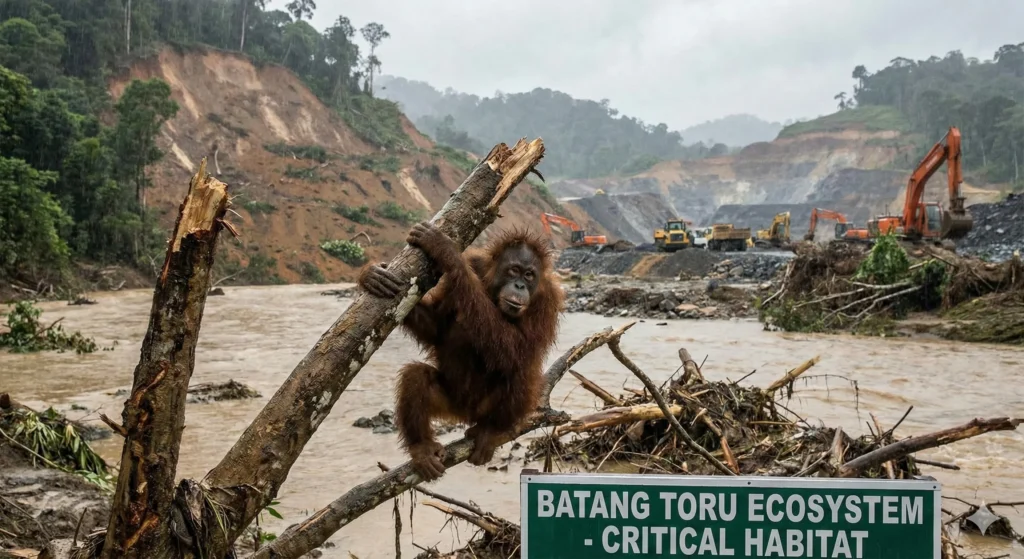
Indonesia Floods Threaten Tapanuli Orangutan. The fragile existence of the world’s rarest great ape faces a new, terrifying threat. Recent Indonesia floods have wreaked havoc across North Sumatra, devastating the Batang Toru ecosystem. This region is the last stronghold of the critically endangered Tapanuli orangutan (Pongo tapanuliensis).
While natural disasters are often seen as acts of nature, environmentalists argue that the severity of these landslides and floods is man-made. With less than 800 individuals remaining in the wild, the destruction of the Tapanuli orangutan habitat has sparked urgent calls for stricter environmental protections against mining firms and infrastructure developers operating in the area. Indonesia Floods Threaten Tapanuli Orangutan.
This article explores the connection between industrial activity, severe flooding, and the potential extinction of our rarest primate relative.
The Devastation in Batang Toru
The Batang Toru ecosystem, located in North Sumatra, is one of the most biodiverse regions in Indonesia. However, recent torrential rains have triggered massive landslides and flash floods.
These Indonesia floods have done more than displace local human communities; they have fractured the already shrinking forest corridors that the orangutans rely on for survival. When the forest floor washes away, the canopy trees that these arboreal apes call home collapse with them.
Key Fact: The Tapanuli orangutan was only identified as a distinct species in 2017. It is the rarest great ape on the planet, with a population lower than the Mountain Gorilla.
Mining Firms and Environmental Accountability
Why are these floods becoming more frequent and deadly? Experts point to rapid deforestation and land conversion.
Conservationists and local NGOs have long warned that the expansion of extractive industries, particularly gold mining and hydroelectric dam projects, destabilizes the soil. The removal of old-growth vegetation reduces the land’s ability to absorb rainwater, leading to the severe Indonesia floods currently witnessed in the region.
The Impact of the Martabe Gold Mine
Recent scrutiny has fallen on operations near the Batang Toru forest, including the proliferation of mining concessions. Critics argue that the expansion of the Martabe gold mine and associated infrastructure has cut into vital buffer zones.
- Soil Erosion: Removal of tree cover loosens the soil.
- Water Runoff: Without trees to slow rainfall, water rushes into river valleys, causing flash floods.
- Habitat Fragmentation: Mining roads split the orangutan population, preventing them from breeding and finding food.
The Tapanuli Orangutan: A Species on the Brink
The Tapanuli orangutan is genetically distinct from its Bornean and Sumatran cousins. They possess frizzier hair, smaller heads, and a unique call. However, their uniqueness makes their potential loss even more tragic.
Why Habitat Loss is Fatal
Unlike other species that might migrate, the Tapanuli orangutan is confined to a tiny area of roughly 1,000 square kilometers. They are strictly arboreal, meaning they rarely travel on the ground. When Indonesia floods and landslides topple trees, the apes are physically trapped.
If the current rate of habitat destruction continues—fueled by mining and exacerbated by climate-induced flooding—experts predict the species could go extinct within a few decades.
A Call for Stricter Environmental Protections
The recent disaster has galvanized global environmental groups to demand action. The call is clear: the Indonesian government must enforce stricter regulations on mining firms to prevent further degradation of the Batang Toru ecosystem.
What Needs to Happen?
To save the Tapanuli orangutan, conservationists are proposing three immediate steps:
- Moratorium on New Licenses: A halt to issuing new mining and energy permits in the Batang Toru complex.
- Reforestation: Immediate efforts to replant native trees in landslide-prone areas to stabilize the soil.
- Corridor Connection: Establishing protected corridors to reconnect fragmented orangutan populations.
Conclusion: A Race Against Time
The Indonesia floods are a wake-up call. They are a visible symptom of an ecosystem pushed to its breaking point. The fate of the Tapanuli orangutan is inextricably less linked to natural selection and more to human decision-making.
Protecting the Batang Toru forest is not just about saving a monkey species; it is about preserving the biodiversity that stabilizes the climate and prevents future disasters. Without stricter controls on mining firms, the world’s rarest ape may disappear along with the forests that protect us all.