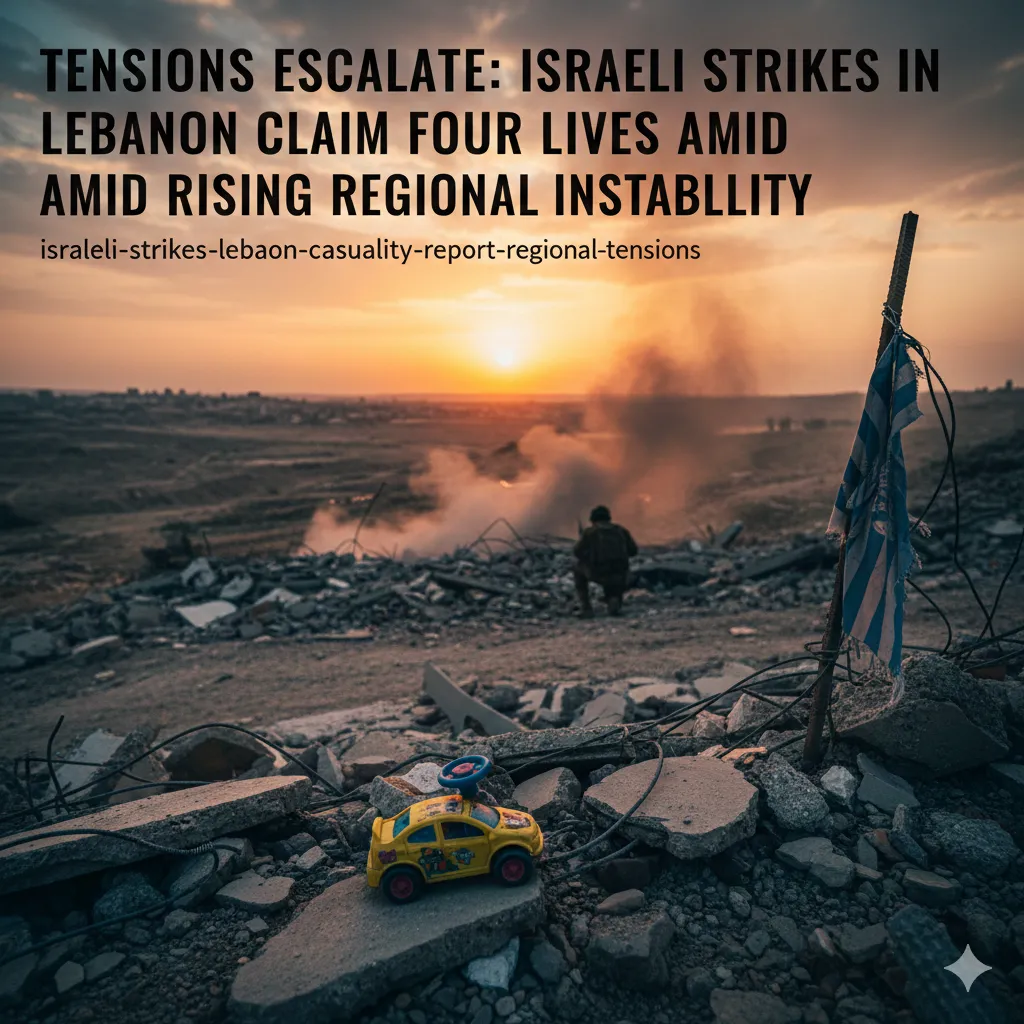
The fragile geopolitical landscape of the Middle East has been pushed to the brink once again. In a significant escalation of cross-border hostilities, recent Israeli strikes in Lebanon have reportedly resulted in the deaths of four individuals. Among the casualties are a security official and, most tragically, a young child.
This latest development comes at a time when the international community was hopeful for a cooling of tensions. Instead, the persistent cycle of violence threatens to derail months of diplomatic back-channeling and ceasefire negotiations.
The Human Toll: Casualties of the Latest Strike
According to local reports and security sources within Lebanon, the strikes targeted specific locations suspected of harboring militant infrastructure. However, the collateral damage has been severe.
- The Security Officer: Reports indicate that one of the deceased was a member of a local security apparatus, highlighting the direct nature of the military engagement.
- The Innocent Victims: The death of a child in these strikes has ignited a wave of grief and condemnation.
- Wider Impact: Beyond the four confirmed fatalities, several others were injured, and residential property sustained significant damage, leading to further displacement in Southern Lebanon.
A Pattern of Heightened Activity
While the world’s attention is often split between various global crises, the “Blue Line”—the UN-recognized border between Israel and Lebanon—has become a flashpoint for near-constant friction.
Despite numerous efforts by the United States, France, and regional mediators to establish a lasting ceasefire, military activity has not ceased. This recent surge is characterized by:
- Precision Targeting vs. Collateral Damage: Israel maintains that its operations are surgical, aimed at neutralizing threats from armed groups like Hezbollah. Conversely, Lebanese authorities point to the rising number of civilian casualties as evidence of disproportionate force.
- Technological Warfare: The use of sophisticated drone technology and long-range missiles has expanded the “theater of war” deeper into Lebanese territory than in previous months.
- Retaliatory Cycles: Each strike often triggers a counter-response, creating a “tit-for-tat” dynamic that makes de-escalation nearly impossible for local leaders to justify to their constituents.
Why Ceasefire Efforts Are Stalling
One might ask: Why hasn’t a ceasefire held? The answer lies in the deeply entrenched strategic goals of the parties involved.
The Security Dilemma
From the Israeli perspective, the presence of armed factions near its northern border represents an existential threat. The objective of the Israeli strikes in Lebanon is often described as “pushing back” these forces to ensure the safety of Israeli citizens in Galilee.
The Sovereignty Issue
For Lebanon, these strikes are viewed as a blatant violation of national sovereignty. The Lebanese government, already grappling with a historic economic collapse, finds itself in a precarious position—unable to fully control the armed groups within its borders while simultaneously being held responsible for their actions.
”The path to peace is blocked not by a lack of dialogue, but by a profound lack of trust. Every strike erodes the foundation upon which a ceasefire could be built.”
The Broader Middle Eastern Context
The situation in Lebanon cannot be viewed in a vacuum. It is intrinsically linked to the broader regional power struggle involving Iran, various proxy groups, and the ongoing conflict in Gaza.
The “Unity of Arenas” strategy employed by certain regional actors means that a flare-up in one area—be it Yemen, Iraq, or Gaza—frequently manifests as increased military pressure on the Lebanese border. This interconnectedness makes a localized ceasefire in Lebanon difficult to maintain without a comprehensive regional settlement.
International Reaction and the Risk of “Total War”
The international community has reacted with a mix of alarm and weary familiarity. The UN Interim Force in Lebanon (UNIFIL) has repeatedly called for restraint, warning that a single miscalculation could ignite a “Total War” that neither side truly wants but both seem prepared to fight.
- The US Position: Washington continues to push for a diplomatic solution, fearing that a full-scale ground invasion of Lebanon would pull the entire region into a chaotic vacuum.
- The EU Perspective: European leaders have emphasized the need to protect Lebanese state institutions to prevent the country from becoming a failed state.
Conclusion: A Fragile Future
The deaths of four people, including a child, serve as a somber reminder of the human cost of political and military deadlock. As Israeli strikes in Lebanon continue, the window for diplomacy appears to be narrowing.
For the residents of Southern Lebanon and Northern Israel, the “new normal” is one of sirens, explosions, and mourning. Without a fundamental shift in the regional security architecture, the cycle of violence is likely to persist, claiming more lives and pushing the Middle East toward an uncertain and dangerous horizon.