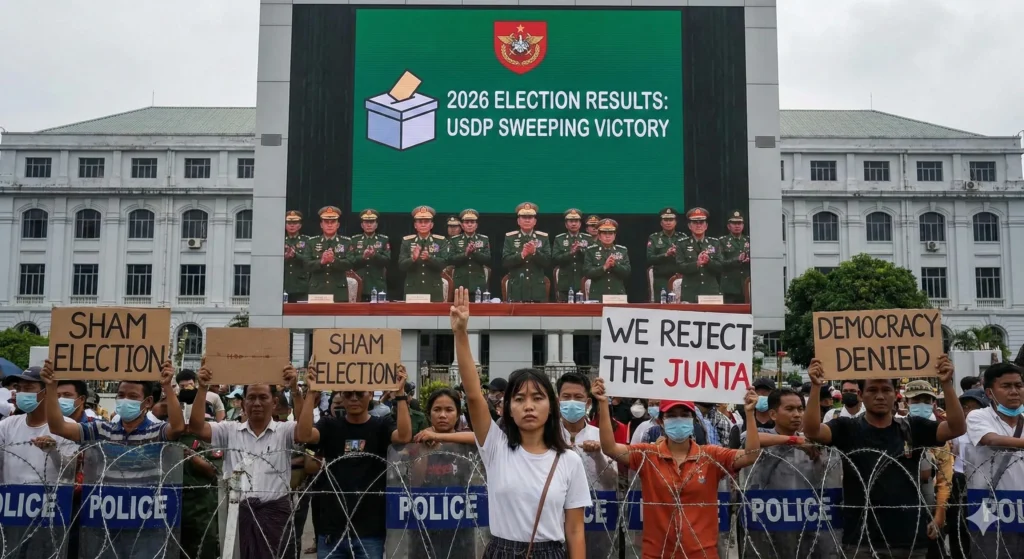
The Myanmar elections have concluded with a predictable yet controversial outcome. The military junta-backed Union Solidarity and Development Party (USDP) has declared a sweeping victory in the country’s first general election since the 2021 coup. While the regime in Naypyidaw hails this as a return to civilian rule, international observers, opposition groups, and human rights organizations have widely denounced the process as a “sham.”
With the country still engulfed in a brutal civil war and the most popular political leaders detained, the Myanmar elections of 2026 have raised more questions than answers about the nation’s future.
A Sweeping Victory for the USDP
According to official results released by the junta-controlled Union Election Commission (UEC) in late January 2026, the USDP has secured a massive majority in both houses of parliament.
The three-phase election, which took place between December 2025 and January 2026, saw the military proxy party win:
- 231 seats in the Pyithu Hluttaw (Lower House).
- 108 seats in the Amyotha Hluttaw (Upper House).
- Total: 339 seats, granting them absolute legislative control.
This “landslide” allows the military to form a new government, expected to take office in April 2026. However, analysts point out that this victory was engineered long before the first ballot was cast.
Why the World Calls It a “Sham”
The term “sham election” has been used by Western governments and the United Nations to describe the Myanmar elections. Several critical factors have stripped the process of credibility:
1. Exclusion of the Opposition
The most popular political force in the country, the National League for Democracy (NLD), was dissolved by the junta prior to the vote. Its leader, Nobel laureate Aung San Suu Kyi, remains in detention, along with thousands of other political prisoners. Without the participation of the NLD, which won landslide victories in 2015 and 2020, millions of voters were left without a genuine choice.
2. Voting in a War Zone
The election took place amidst an active and bloody civil war. Large swathes of the country are under the control of the People’s Defense Forces (PDF) and Ethnic Armed Organizations (EAOs). In these resistance-held territories, voting was impossible. Consequently, the election was held only in junta-controlled pockets, disenfranchising a significant portion of the population.
3. Coercion and Fear
Reports from the ground indicate that voters faced immense pressure. Civil servants and citizens in junta-controlled areas were reportedly threatened with arrest or fines if they did not cast their ballots.
Note: The “Election Protection Law” passed in 2025 criminalized any speech or protest that disrupted the electoral process, effectively silencing all dissent.
International Reactions: A Divided World
The reaction to the Myanmar elections highlights the deep geopolitical divide surrounding the crisis.
- The West & UN: The United States, European Union, and United Nations have unequivocally rejected the results. They argue that an election held under a state of emergency, with opposition leaders jailed, cannot be free or fair.
- ASEAN: The Association of Southeast Asian Nations (ASEAN) refused to send observers, maintaining that the junta has failed to implement the “Five-Point Consensus” for peace.
- China & Russia: In contrast, the junta’s primary arms suppliers—China and Russia—sent observers to monitor the polls. They have signaled readiness to work with the incoming government, prioritizing stability and economic interests over democratic norms.
What Comes Next for Myanmar?
The conclusion of the Myanmar elections does not signal an end to the conflict. If anything, it may escalate the violence.
The newly elected government will struggle for legitimacy. The shadow National Unity Government (NUG), which operates in exile and in resistance territories, has declared the election null and void. They have vowed to continue the “Spring Revolution” until the military is removed from power.
Economic Implications
The sham election is unlikely to lead to the lifting of Western sanctions. Foreign direct investment will likely remain low as instability persists. However, the junta hopes that the veneer of a “civilian government” will allow them to normalize relations with neighboring countries like Thailand and India, who are concerned about border stability and refugee flows.
Conclusion
The 2026 Myanmar elections were designed to cement the military’s grip on power rather than restore democracy. By excluding the opposition and conducting polls during a civil war, the junta has achieved a technical victory but failed to gain the political legitimacy it desperately seeks. As the new government prepares to take charge in April, the world watches to see if this “managed transition” will bring stability or plunge the nation deeper into chaos.
FAQ: Myanmar Elections 2026
1. Who won the Myanmar elections in 2026?
The military-backed Union Solidarity and Development Party (USDP) declared a landslide victory, winning the majority of seats in both houses of parliament.
2. Why are the elections considered a sham?
They are called a sham because the main opposition party (NLD) was banned, key leaders like Aung San Suu Kyi are jailed, and voting only occurred in military-controlled areas during a civil war.
3. Did the UN monitor the Myanmar elections?
No, the UN and most Western nations refused to send observers, stating the conditions for a free and fair election were not met. Only countries like Russia and China sent monitors.