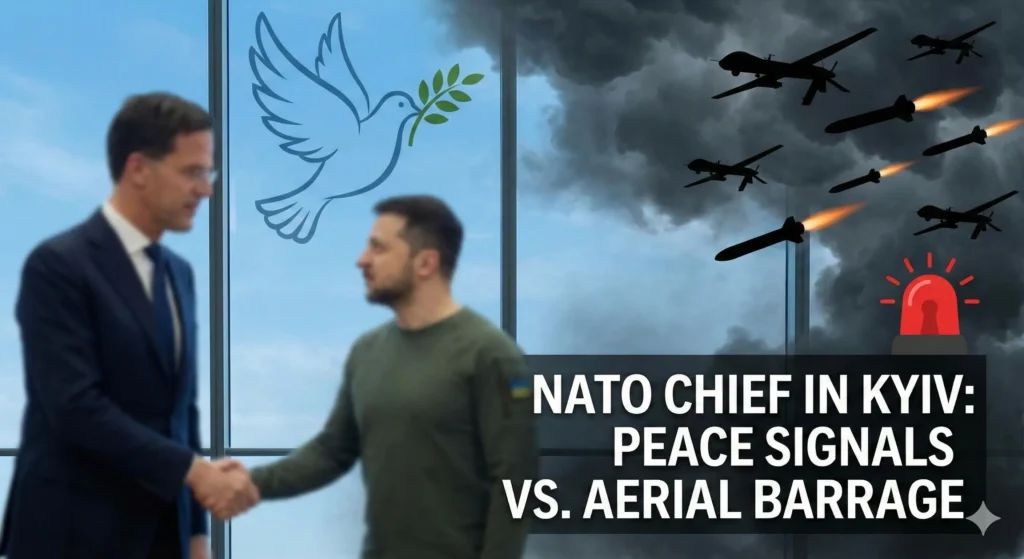
The geopolitical landscape of Eastern Europe shifted dramatically today as NATO Chief in Kyiv, Secretary General Mark Rutte, made a high-stakes, unannounced visit to the Ukrainian capital. The visit comes at a precarious moment in the conflict, characterized by a jarring dichotomy: tentative diplomatic signals for a “peace deal” juxtaposed against one of the most ferocious aerial bombardments since the start of the full-scale invasion.
While Ukrainian President Volodymyr Zelenskyy signaled a potential readiness to “play ball” regarding negotiations, the reality on the ground—a massive overnight barrage involving 450 drones and 70 missiles—suggests that the road to peace remains heavily mined.
A Surprise Visit with Heavy Implications
The arrival of the NATO Chief in Kyiv was shrouded in secrecy until the official handshake. Mark Rutte’s presence sends a deliberate message of unwavering solidarity from the North Atlantic Treaty Organization. However, the timing is critical. With winter approaching and the frontlines grinding into a war of attrition, Western allies are keen to understand Kyiv’s long-term strategy.
Rutte’s agenda likely extends beyond photo opportunities. Key discussion points almost certainly included:
- Air Defense Systems: Urgent requests for more Patriots and IRIS-T systems to counter the escalating drone swarms.
- NATO Membership Path: The perennial question of Ukraine’s invitation to the alliance, a red line for Russia but a security guarantee for Kyiv.
- Peace Negotiations: Clarifying what an acceptable “endgame” looks like for Ukraine and its Western backers.
Key Takeaway: Rutte’s visit is not just a show of support; it is a strategic audit of the war effort as diplomatic pressure for a resolution mounts globally.
The “Bad Signal”: Analyzing the Massive Overnight Attack
While diplomats spoke in corridors, the skies over Ukraine told a different story. Just hours before the NATO Chief in Kyiv was set to meet Zelenskyy, Russia launched a staggering aerial assault.
The numbers reported are unprecedented:
- 450 Attack Drones: Likely Shahed-136/131 loitering munitions, designed to overwhelm air defenses by sheer volume.
- 70 Missiles: A mix of cruise and ballistic missiles targeting critical infrastructure and residential hubs.
The Tactical Shift
This volume of fire—specifically the use of 450 drones in a single wave—represents a tactical evolution. Russia is attempting to deplete Ukrainian air defense interceptors faster than Western allies can replenish them. By saturating the radar landscape, they increase the probability of missiles slipping through the net to hit energy grids and military logistics.
President Zelenskyy did not mince words regarding the timing of this attack. He explicitly stated that such aggression sends a “bad signal” for any prospective negotiations. It is difficult to sit at a table when the adversary is actively escalating the violence to record levels.
Zelenskyy’s Dilemma: “Playing Ball” vs. Fighting Back
Perhaps the most intriguing development from the NATO Chief in Kyiv visit is the shift in rhetoric from the Ukrainian President. Zelenskyy’s comment about being ready to “play ball” on a peace deal marks a subtle but significant pivot from the “total victory” narrative that has dominated the last two years.
What Does “Playing Ball” Mean?
This phrase likely indicates a willingness to discuss:
- Ceasefire Terms: Conditions under which active combat might pause.
- Security Guarantees: Instead of immediate NATO membership, perhaps a “porcupine” strategy of armed neutrality guaranteed by key Western powers.
- Territorial Realities: While Ukraine legally claims its 1991 borders, the de facto line of control might become a subject of temporary status discussions, similar to the West/East Germany model, though this remains politically radioactive in Kyiv.
However, Zelenskyy qualified this readiness heavily. The Russian attack serves as proof, in his view, that Moscow is not interested in genuine diplomacy but is using violence to force capitulation rather than compromise.
NATO’s Role in the Next Phase of the War
With NATO Chief in Kyiv, the Alliance is signaling that it will not be bullied into abandoning Ukraine, regardless of negotiation talk. Mark Rutte’s leadership is pivotal here. Known for his pragmatic approach, Rutte understands that for Ukraine to negotiate effectively, it must do so from a position of strength, not desperation.
The Logistics of Survival
The discussion between Rutte and Zelenskyy likely focused on the sustainability of the war effort. The “450 drones” figure is a wake-up call for European defense production. If Russia can source or produce thousands of drones, NATO’s industrial base must pivot to producing cost-effective counter-measures, such as electronic warfare (EW) jammers and kinetic anti-drone systems (like the Gepard), rather than spending million-dollar Patriot missiles on $20,000 drones.
The Global Context: Why Now?
Why is the NATO Chief in Kyiv now, and why is Zelenskyy talking about deals? Several factors are converging:
- US Political Climate: With election cycles in the US influencing aid packages, there is pressure to show a “plan” that leads to a resolution.
- War Fatigue: European populations are facing economic strains, making indefinite funding of a stalemate a harder sell.
- Winter Warfare: Russia often uses winter to weaponize energy; the massive missile attack is a precursor to a campaign against Ukraine’s power grid.
Conclusion: A Fragile Balance
The unannounced visit of the NATO Chief in Kyiv has illuminated the complex dual track Ukraine is currently navigating: preparing for the possibility of peace talks while simultaneously bracing for the most intense combat of the war.
Mark Rutte’s presence reinforces Western commitment, but the 450 drones and 70 missiles raining down serve as a brutal reminder that the Kremlin gets a vote in when this war ends. Zelenskyy’s willingness to “play ball” offers a glimmer of hope for diplomacy, but as he rightly noted, bombs make for poor negotiating partners.
As the dust settles on Kyiv, the world watches to see if this visit yields more weapons, a new diplomatic framework, or simply a steeling of resolve for the long winter ahead.
Frequently Asked Questions (FAQ)
Why was the NATO Chief in Kyiv today?
NATO Secretary General Mark Rutte made an unannounced visit to reaffirm NATO’s support for Ukraine, discuss air defense needs, and strategize on future peace negotiations amidst escalating Russian attacks.
What was the scale of the Russian attack mentioned?
Russia launched a massive overnight attack consisting of 450 drones and 70 missiles, targeting various regions across Ukraine. It is one of the largest combined aerial strikes of the war.
What did Zelenskyy say about peace negotiations?
President Zelenskyy signaled a readiness to “play ball” regarding a peace deal but emphasized that the massive Russian attack sends a “bad signal,” undermining trust in Moscow’s willingness to negotiate in good faith.
Who is Mark Rutte?
Mark Rutte is the Secretary General of NATO. He was previously the Prime Minister of the Netherlands and is a key figure in coordinating Western military aid to Ukraine.