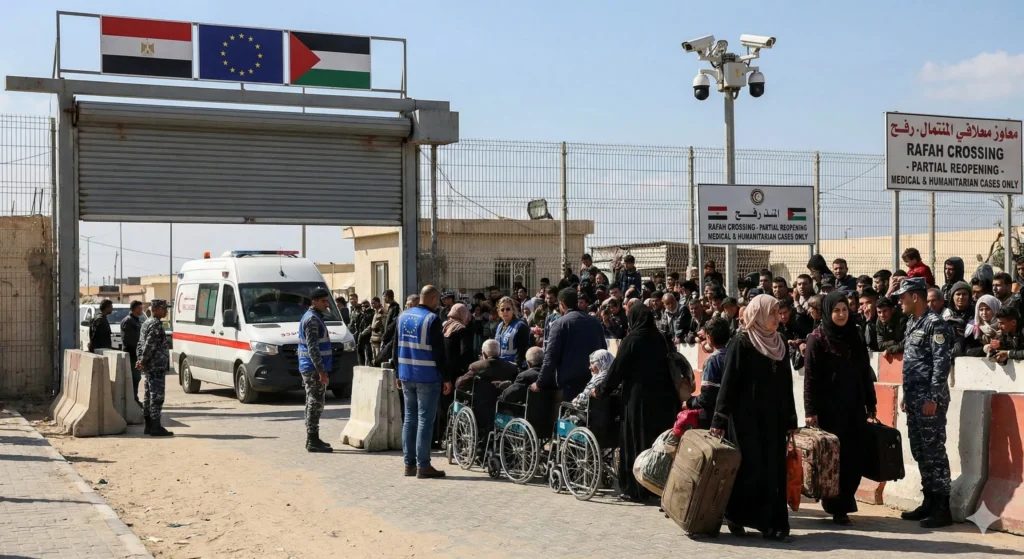
The Rafah border crossing reopening on Monday marked a pivotal, albeit fragile, moment in the ongoing Gaza crisis. After nearly two years of closure following its seizure by Israeli forces in May 2024, the gates between Gaza and Egypt have partially swung open. For the 2.3 million Palestinians trapped in the enclave, this development is a glimmer of hope. However, aid agencies and health officials warn that without a significant increase in capacity, this move remains largely symbolic in the face of a catastrophic humanitarian reality.
In this article, we dive deep into the details of the reopening, the strict new protocols, and the heartbreaking reality for the thousands of patients still waiting for a chance to survive.
The 2026 Reopening: Breaking the Blockade
On February 2, 2026, the first trickle of travelers crossed the border under a new, U.S.-brokered ceasefire agreement. This event signifies the first time in nearly two years that the Rafah border crossing reopening has allowed for regular, albeit limited, pedestrian movement.
The atmosphere at the terminal was a mix of relief and desperation. Images from the border showed children in wheelchairs and elderly patients waiting to be ferried into Egypt. According to the World Health Organization (WHO), five patients and seven companions were successfully evacuated on the first day. While this is a positive step, it stands in stark contrast to the overwhelming need.
Key Details of the New Arrangement
- Daily Quotas: Israel has agreed to allow approximately 50 patients (plus companions) to exit daily, and 50 Palestinians to enter Gaza.
- Management: The crossing is now managed by a European Union team under the EU Border Assistance Mission, with remote monitoring by Israeli security forces.
- No Cargo: Crucially, the crossing remains closed to commercial goods and large-scale humanitarian aid trucks, which are vital for fighting the ongoing famine conditions.
A “Symbolic” Lifeline: The Medical Evacuation Crisis
While the headlines celebrate the Rafah border crossing reopening, the numbers tell a different, more harrowing story. The Gaza Health Ministry and international NGOs have labeled the current evacuation rate as a “drop in the ocean.”
The Numbers Don’t Add Up
Currently, there are over 18,500 to 20,000 patients in Gaza who require urgent, specialized medical treatment abroad. These are not just elective surgeries; they are cases of severe war trauma, advanced cancer, and chronic kidney failure that cannot be treated in Gaza’s decimated healthcare system.
At the current rate of 50 evacuations per day, clearing the backlog would take over a year—time that many of these patients simply do not have.
“These are very, very small numbers. The backlog must be dealt with meaningfully to avoid putting further pressure on an already fragile ceasefire.” — Sam Rose, UNRWA Director.
Medical Aid for Palestinians (MAP) has reported that patients have already died while waiting for the border to open. For them, the Rafah border crossing reopening came too late. The strict vetting process and the slow pace of transfers mean that for every patient who leaves, dozens more remain in critical condition.
Political Context: Why Now?
The timing of the Rafah border crossing reopening is inextricably linked to the broader geopolitical landscape of 2026. It is a key component of “Phase 2” of the regional ceasefire agreement championed by the U.S. administration.
Pressure has been mounting on Israel from the international community, particularly the European Union and Egypt, to alleviate the suffering of civilians. The return of the final Israeli hostage, Ran Gvili, last week also removed a significant political hurdle that Israel had set as a precondition for reopening the terminal.
However, trust remains low. Hamas has welcomed the opening but criticized the heavy Israeli restrictions, which they argue are designed to hinder movement rather than facilitate it. The involvement of the EU as a neutral third party is intended to mitigate these tensions, but the remote surveillance by Israeli intelligence ensures that Tel Aviv retains ultimate control over who enters and exits.
Strict Restrictions and New Protocols
Travelers hoping to utilize the Rafah border crossing reopening face a rigorous and invasive security screening process. Unlike the pre-2024 era, the new protocols utilize advanced facial recognition technology and require prior approval from both Israeli and Egyptian intelligence services.
The Screening Process
- Application: Residents must apply for travel permits weeks in advance.
- Vetting: Names are cross-referenced against Israeli security databases.
- Transit: Approved travelers are processed through the EU-managed terminal, but their biometric data is shared with Israeli monitors in real-time.
- Exclusion: Men of “fighting age” (typically 18-50) face the highest rejection rates, often leaving families separated at the border.
These restrictions have drawn sharp criticism from human rights organizations, who argue that the right to freedom of movement is being treated as a bargaining chip rather than a fundamental human right.
Humanitarian Impact and Future Outlook
The Rafah border crossing reopening is a test case for the durability of the current ceasefire. If the process runs smoothly and security incidents are avoided, there is hope that the daily quotas could be increased. Conversely, any security breach could lead to an immediate re-closure, trapping the population once again.
For the residents of Gaza, the psychological impact is profound. The reopening symbolizes a reconnection with the outside world, a restoration of a basic lifeline. Yet, the exclusion of cargo and trade means that the economic strangulation of the strip continues. Without the flow of goods, reconstruction efforts cannot begin in earnest, and the famine that plagues the north of Gaza will remain unaddressed by this specific measure.
What Needs to Happen Next?
For this reopening to be a genuine success, three things must happen:
- ** increased Quotas:** The number of daily evacuees must rise from 50 to at least 500 to address the medical backlog.
- Commercial Access: The crossing must eventually open to trade to revive Gaza’s economy.
- Sustained Stability: All parties must adhere to the ceasefire terms to prevent another closure.
Frequently Asked Questions (FAQ)
Is the Rafah border crossing fully open?
No, the Rafah border crossing reopening is partial. It is currently open only for limited medical evacuations and a small number of travelers. No commercial goods are passing through.
Who manages the Rafah crossing now?
As of February 2026, the crossing is managed on the ground by the European Union Border Assistance Mission (EUBAM) and Egyptian authorities, with remote security monitoring by Israel.
How many people can leave Gaza daily?
Under the current agreement, approximately 150 people are permitted to leave daily, which includes 50 patients and their companions.
Can aid trucks enter through Rafah?
Currently, no. The crossing is designated for pedestrians only. Aid trucks are still routed through the Kerem Shalom crossing, which is subject to frequent delays and blockades.
Conclusion
The Rafah border crossing reopening is a significant milestone in the post-2024 Gaza conflict timeline. It represents a diplomatic breakthrough and a literal lifeline for the few who can cross. However, we must not mistake a crack in the door for freedom.
With 20,000 patients waiting and millions relying on a trickle of aid, the international community must push for this initial step to evolve into a full reopening. Until then, the crisis in Gaza remains acute, and the reopening serves as a reminder of both the progress made and the massive distance left to travel.