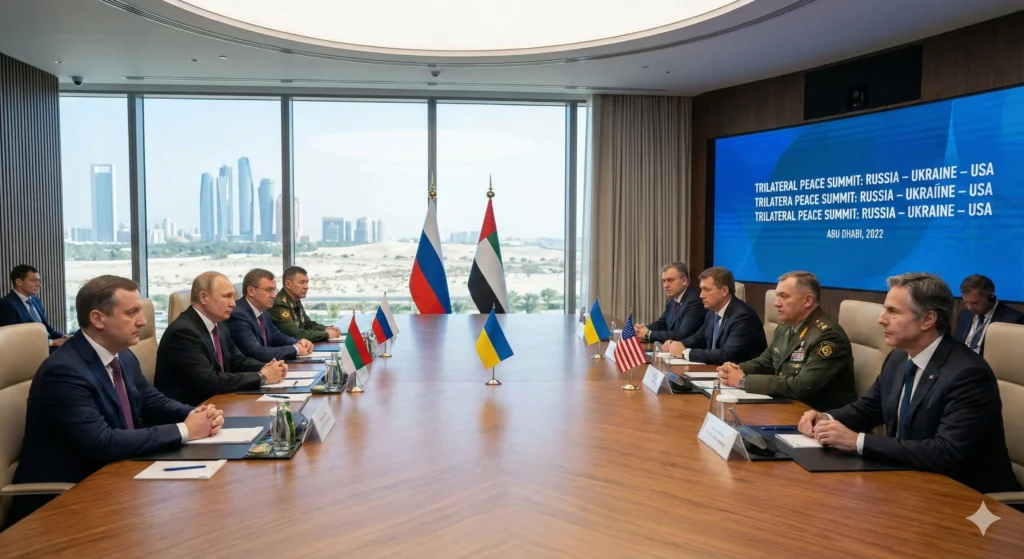
Russia-Ukraine-US Peace Talks: High-Stakes Peace Negotiations Begin in UAE (2026). For the first time since the 2022 invasion, high-level delegations from Russia, Ukraine, and the United States have convened for direct trilateral peace talks in Abu Dhabi. With the US administration pushing for a resolution, the negotiations face a critical deadlock: Russia is enforcing maximalist territorial demands in the Donbas, while Ukraine insists on ironclad security guarantees.
A Historic Diplomatic Breakthrough in Abu Dhabi
The geopolitical landscape shifted this Friday, January 23, 2026, as negotiating teams from Washington, Moscow, and Kyiv met in the United Arab Emirates. This marks the first direct trilateral negotiation involving all three powers since the conflict began nearly four years ago.
Hosted by the UAE, these talks represent a significant pivot in diplomatic efforts. Following a meeting between US President Donald Trump and Ukrainian President Volodymyr Zelenskyy in Davos—and a simultaneous high-stakes visit by US envoys to the Kremlin—the parties have moved from shadow diplomacy to the negotiating table.
Key Takeaway: The mere existence of these talks is a breakthrough, but the gap between the warring parties remains immense.
The Core Conflict: Territory vs. Security
As the talks entered their second day on Saturday, the conflicting agendas became starkly clear. The negotiations are reportedly deadlocked on two “non-negotiable” pillars.
1. Russia’s Maximalist Territorial Demands
Despite the diplomatic setting, the Kremlin has not softened its stance. Russian officials, led by GRU military intelligence director Gen. Igor Kostyukov, have reportedly demanded the total withdrawal of Ukrainian forces from the Donbas region.
- The Demand: Full control over the Donetsk and Luhansk regions.
- The Reality: Ukraine currently holds approximately 20% of Donetsk, territory it has successfully defended through years of attrition.
- Kremlin Statement: Spokesperson Dmitry Peskov emphasized that a Ukrainian withdrawal from Donbas is a “very important condition” for any ceasefire.
2. Ukraine’s Demand for Security Guarantees
President Zelenskyy has made it clear that conceding territory without robust protection is a non-starter. The Ukrainian delegation, led by National Security Council Secretary Rustem Umerov, is focused on securing binding security commitments that prevent future aggression.
- The Strategy: Ukraine is leveraging the US presence to demand guarantees that go beyond empty promises (like the 1994 Budapest Memorandum).
- Zelenskyy’s Stance: “The main, core agreement on security guarantees is ready,” but he warns that ceding land under pressure would only embolden Russia.
Why the UAE?
The choice of Abu Dhabi as the venue highlights the United Arab Emirates’ rising status as a neutral geopolitical broker.
- Trust: The UAE has maintained working relationships with Washington, Moscow, and Kyiv throughout the war.
- Track Record: The country has successfully mediated 17 prisoner exchanges between Russia and Ukraine, releasing over 4,000 detainees.
- Host: UAE Foreign Minister Sheikh Abdullah bin Zayed Al Nahyan welcomed the talks, positioning the Emirates as a bridge-builder in a polarized world.
What Happens Next?
As the talks conclude their scheduled window on January 24, 2026, the world watches for two outcomes:
- A Ceasefire Framework: A temporary halt to fighting to allow for further negotiations.
- Collapse: If Russia refuses to drop its demand for the 20% of Donetsk held by Ukraine, the talks could dissolve, leading to a renewed spring offensive.
Immediate Next Step: Monitor the joint statements expected later today. If a “working group on security issues” is formalized, it signals that the talks were a success, even without an immediate peace treaty.
Frequently Asked Questions (FAQ)
Q: Is the war over?
A: No. These are preliminary peace talks. Fighting continues on the ground, and significant hurdles remain.
Q: What is the US role in these talks?
A: The US is acting as a primary mediator/guarantor. The Trump administration is pushing for a swift resolution to pivot focus to other global challenges.
Q: Why is the Donbas region so important?
A: For Russia, capturing the full Donbas is a primary war goal. For Ukraine, holding it is a symbol of resistance and sovereignty.