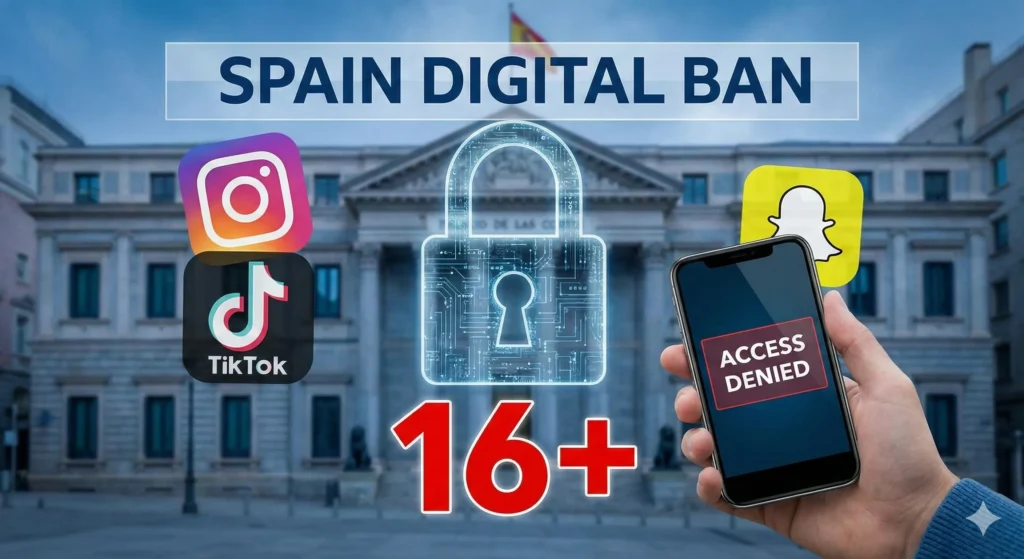
In a move that could redefine the digital landscape for the next generation, Spain to ban social media for under-16s is no longer just a rumor—it is a government priority. Spanish Prime Minister Pedro Sánchez has officially announced a comprehensive strategy to restrict access to social platforms for minors, placing the burden of enforcement squarely on Big Tech.
This bold initiative, dubbed the “Digital Coming of Age”, aims to combat the rising tide of screen addiction, cyberbullying, and mental health issues among youth. But how will it work? And can it truly be enforced?
Below, we dive deep into the details of the proposed law, the technological hurdles, and the global ripples this decision is making.
Table of Contents
- The Core of the Proposal: What is the Digital Coming of Age?
- Why Now? The Mental Health Crisis
- How Will the Ban Be Enforced?
- The Global Context: Spain is Not Alone
- Pros and Cons: The Debate Heats Up
- Conclusion: A New Era for the Internet?
The Core of the Proposal: What is the Digital Coming of Age?
Prime Minister Pedro Sánchez’s administration has drafted a bill focused on the protection of minors in digital environments. Unlike previous regulations that relied on parental controls or self-regulation by tech companies, this new legislation proposes a hard legal limit: no social media accounts for anyone under the age of 16.
Currently, the minimum age for data consent in Spain is 14, though many platforms allow users as young as 13 (or younger, due to lax verification). The new law raises this threshold to 16, aligning it with some of the strictest standards in Europe.
Key Components of the Bill:
- Mandatory Age Verification: Platforms will be legally required to implement robust systems to verify the age of all users to ensure no under-16s are slipping through the cracks.
- Parental Control Tools: Devices (smartphones, tablets) will come with factory-activated parental controls that cannot be easily disabled by minors.
- Heavy Fines: Social media giants like Instagram, TikTok, and Snapchat could face massive financial penalties for non-compliance.
- Digital Literacy Education: The bill also includes provisions for better education regarding digital citizenship in schools.
Note: The goal isn’t just to ban access, but to create a “sanctuary” for childhood, free from the algorithmic pressures of the attention economy.
Why Now? The Mental Health Crisis
The decision for Spain to ban social media for under-16s stems from growing alarm over the mental health of Spanish youth. Health experts and sociologists have long warned that the “unregulated experiment” of social media is causing tangible harm.
The Statistics Are Alarming
Recent studies in Spain and across Europe have shown a direct correlation between heavy social media use and:
- Increased Anxiety and Depression: The constant comparison culture affects self-esteem, particularly in teenage girls.
- Sleep Deprivation: The “infinite scroll” keeps minors awake late into the night, affecting cognitive development.
- Cyberbullying: Online harassment follows children home from school, leaving them no safe space.
- Exposure to Harmful Content: Algorithms frequently push content related to eating disorders or self-harm to vulnerable users.
By raising the age limit to 16, the Spanish government hopes to protect children during their most critical developmental years, allowing them to mature socially in the real world before entering the digital one.
How Will the Ban Be Enforced?
This is the billion-dollar question. Legislating a ban is easy; enforcing it on the internet is notoriously difficult. Tech-savvy teenagers are experts at bypassing restrictions using VPNs or simply lying about their birth date.
To combat this, the Spanish government is demanding strict age verification.
The Technology Challenge
Currently, most platforms use a simple “tick box” where users confirm they are over 13. This is easily bypassed. The new Spanish law will likely require:
- Digital ID Integration: Linking account creation to official government IDs or the upcoming European Digital Identity Wallet.
- Biometric Estimation: Using facial estimation technology (which estimates age without identifying the person) to flag underage users.
- Third-Party Verification: Using independent services to verify age without the social media platform ever seeing the user’s ID documents, preserving privacy.
The Privacy Paradox:
Critics argue that strict age verification creates a privacy nightmare for adults. To prove you are over 16, you effectively have to hand over your ID to social media companies or third parties. Balancing child safety with user privacy will be the biggest hurdle for the Sánchez administration.
The Global Context: Spain is Not Alone
Spain is not operating in a vacuum. The move to ban social media for under-16s is part of a growing global trend where governments are reclaiming control from Silicon Valley.
- Australia: Recently announced plans to ban social media for under-16s, with the Prime Minister citing that social media is “doing harm to our kids.”
- United Kingdom: The Online Safety Act imposes strict duties on platforms to protect children, though it stops short of a total ban for under-16s.
- USA (Florida & Others): Several states have passed or proposed legislation restricting social media access for minors, requiring parental consent or banning it entirely for younger demographics.
Spain’s “Digital Coming of Age” positions the country as a leader in the European Union’s fight for digital regulation. If successful, Spain could provide the blueprint for the rest of the EU.
Pros and Cons: The Debate Heats Up
While many parents are breathing a sigh of relief, the proposal has sparked intense debate among digital rights activists, tech experts, and teenagers themselves.
The Arguments For the Ban
- Restoring Childhood: It allows children to play, socialize, and learn without the pressure of likes and views.
- Reducing Predatory Behavior: Fewer minors online means fewer opportunities for online predators to contact them.
- Empowering Parents: It gives parents the legal backing to say “no” to smartphones and social media apps.
The Arguments Against the Ban
- Isolation: For marginalized youth (e.g., LGBTQ+ teens in unsupportive households), social media is often a lifeline to finding community.
- The “Forbidden Fruit” Effect: Banning it may make social media more desirable, leading teens to access it via darker, less regulated corners of the internet.
- Technical Feasibility: If the age verification is too intrusive, users may revolt. If it’s too weak, the law becomes a joke.
Conclusion: A New Era for the Internet?
Spain’s decision to ban social media for under-16s marks a pivotal moment in the history of the internet. It signals the end of the “wild west” era of social media and the beginning of a regulated, safety-first approach.
While the implementation will undoubtedly face technical and legal challenges, the message from Madrid is clear: the mental health of the next generation is more important than the engagement metrics of social media giants.