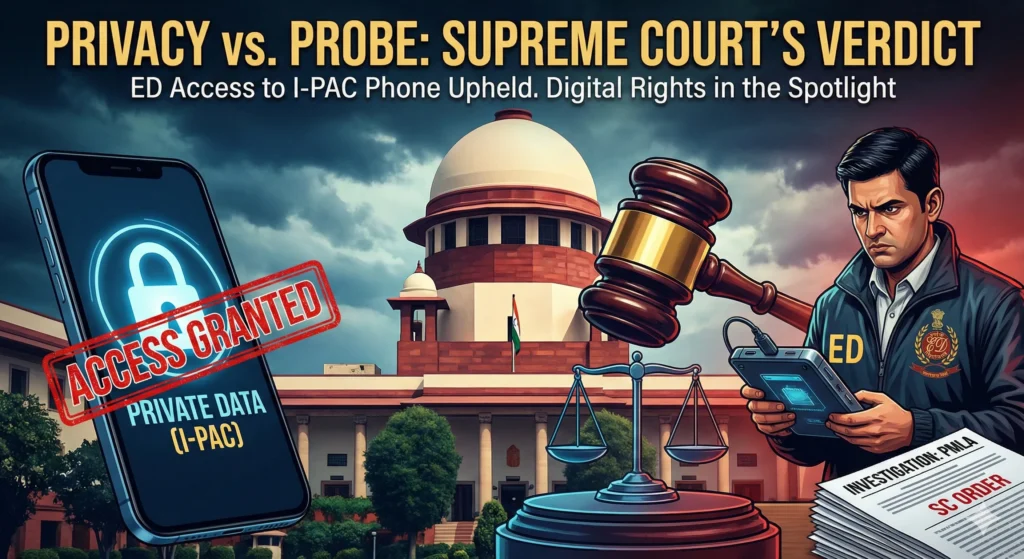
Supreme Court & Privacy. In a massive development that has shaken the corridors of power and privacy advocates alike, the Supreme Court of India has effectively prioritized investigation rights over individual privacy in a recent high-profile case.
The case involves the Enforcement Directorate (ED), the Indian Political Action Committee (I-PAC), and a clash that highlights the tension between your smartphone’s secrets and the state’s need to uncover the truth.
If you’ve been following the news, you know this isn’t just about one phone; it’s a precedent-setting moment for digital rights in India. Let’s break down what happened, why the SC ruled this way, and what it means for the future of privacy.
📱 The Case: ED vs. The “Privacy Shield”
At the heart of this legal battle is a probe into a massive alleged coal scam and money laundering case. The ED has been investigating financial trails that led them to the offices of I-PAC (a political consultancy firm) and the residence of its executives in Kolkata.
Here is the sequence of events that led to the Supreme Court showdown:
- The Raid: ED officials conducted search and seizure operations at I-PAC offices and the home of its director, Pratik Jain.
- The “Obstruction”: The ED alleged that the State machinery (including top political figures) interfered with the raid.
- The Missing Evidence: The agency claimed that crucial digital evidence—specifically mobile phones and laptops—was “snatched” or removed from their custody during the chaos.
- The Plea: The ED moved the Supreme Court, arguing that they cannot investigate if suspects (or state authorities) hide behind privacy or political shields to withhold digital devices.
The Core Argument
The legal defense for the executives often rests on the Right to Privacy (declared a fundamental right in the Puttaswamy judgment). The argument is simple: My phone contains my entire personal life, and the state shouldn’t have unfettered access to it.
However, the ED counter-argued that privacy cannot be a hiding place for crime. If a device contains evidence of money laundering, the “right to privacy” cannot stop a federal agency from accessing it.
⚖️ The Supreme Court’s Stance: Investigation Comes First
The Supreme Court’s response was swift and significant. By issuing notices and staying FIRs filed against the ED officials, the Court signaled a clear stance: State machinery or privacy claims cannot obstruct a lawful federal investigation.
While the final detailed judgment on the technicalities of “phone unlocking” is evolving, the SC’s rejection of the plea to block the ED essentially establishes the following:
- No Absolute Immunity: Being a political consultant or a private executive does not grant immunity from digital searches.
- Evidence Protection: The Court took serious note of the allegation that evidence (phones) was removed. This suggests that the integrity of evidence outweighs the immediate privacy concerns of the accused during an active raid.
- Federal Authority: The ruling reinforces the ED’s power to seize digital devices across state lines without local interference.
Key Takeaway: The Supreme Court is making it clear that while you have a right to privacy, it is not absolute. It dissolves when there is a reasonable suspicion of serious crimes like money laundering.
🔍 What This Means for Digital Privacy in India
This ruling is a wake-up call for anyone thinking their digital data is untouchable.
1. The “Self-Incrimination” Debate
A major legal question remains: Can you be forced to give up your password?
Under Article 20(3) of the Constitution, you cannot be compelled to be a witness against yourself. However, courts are increasingly distinguishing between “giving a statement” and “producing a device.”
- Giving a password might be seen as testimonial (protected).
- Handing over a phone (the physical device) is often seen as producing a document (not protected). The ED can seize the device and use forensics to open it, with or without your help.
2. Corporate Anxiety
For executives and consultants (like those at I-PAC), this is a red flag. Corporate phones often mix personal chats with business data. This ruling suggests that if the ED knocks, that “mixed data” argument won’t stop a seizure.
3. State vs. Center
This wasn’t just about privacy; it was a federal showdown. The SC’s intervention prevents State Governments from using “law and order” or “privacy” as excuses to block Central Agencies (ED/CBI) from doing their job.
🚀 The Bottom Line
The Supreme Court has drawn a line in the sand. In the battle of Privacy vs. Probe, the probe is winning—especially when money laundering is involved.
The rejection of the plea to stop the ED acts as a precedent: If you are under investigation, your digital life is open for inspection. The “Right to Privacy” is a shield for the innocent, not a vault for the accused to hide evidence.
What do you think? Should there be stricter warrants required before the ED seizes a phone, or is this necessary to catch modern white-collar criminals?
Frequently Asked Questions (FAQ)
Here are the most common questions regarding the Supreme Court’s recent stance on the Enforcement Directorate (ED) and digital privacy.
1. Can the Enforcement Directorate (ED) legally seize and check my phone?
Yes. Under the Prevention of Money Laundering Act (PMLA), the ED has the authority to search and seize records, which includes digital devices like mobile phones, laptops, and hard drives. If they have a reasonable belief that the device contains evidence related to a crime, they can take it into custody for forensic examination.
2. Does the “Right to Privacy” protect my phone from being searched?
Not entirely. While the Supreme Court (in the Puttaswamy judgment) declared privacy a fundamental right, it is not absolute. It is subject to “reasonable restrictions,” such as the prevention and investigation of crime. In the recent I-PAC case, the SC ruled that privacy cannot be used as a shield to block a lawful investigation into serious offenses like money laundering.
3. Can I refuse to give my password to the ED during a raid?
This is a complex legal area. Article 20(3) of the Indian Constitution protects you from being “compelled to be a witness against yourself” (self-incrimination). However, many courts currently distinguish between giving a confession and unlocking a device. Unlocking a phone is often viewed as “producing a document” or material evidence, which you may be legally required to do, unlike giving a verbal confession. Refusal can sometimes lead to additional legal complications or “non-cooperation” charges.
4. What was the Supreme Court’s ruling in the I-PAC vs. ED case?
The Supreme Court rejected a plea by an I-PAC executive to restrain the ED from accessing their seized mobile phone. The Court essentially prioritized the federal agency’s right to investigate a potential scam over the individual’s immediate claim to privacy. The Court also stayed FIRs filed by the local State Police against the ED officials, signaling that local authorities cannot obstruct federal probes.