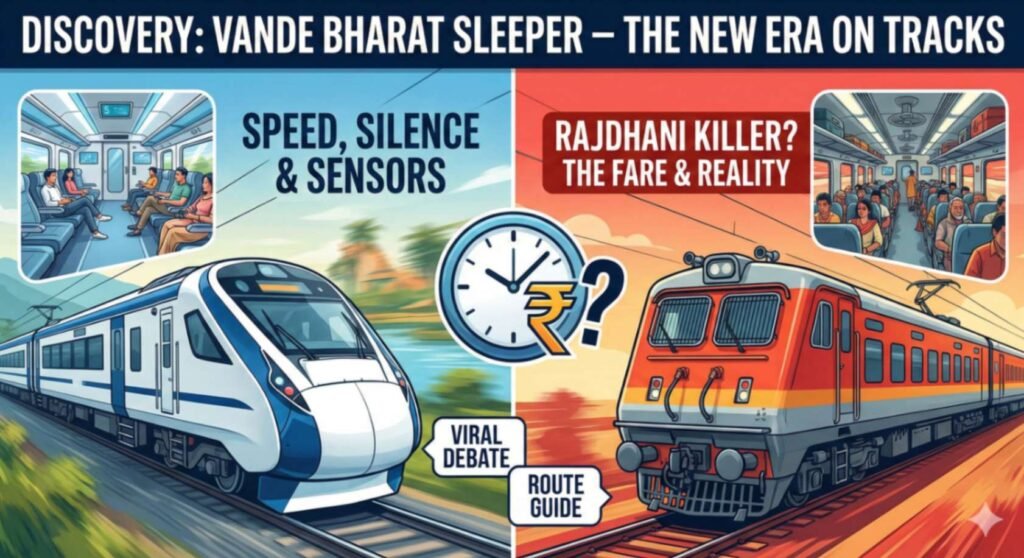
The Lead: A New Era on Tracks
If you have been scrolling through social media this week, you have likely seen two things: sleek videos of the new Vande Bharat Sleeper train zooming past paddy fields, and viral clips of… paper cups littered on its floor.
Flagged off just days ago on the Howrah-Kamakhya route, this train is India’s answer to European-style rail travel. But beyond the ribbon-cutting and the Instagram reels, is it actually worth the ticket price? We dive into the reality of India’s most hyped train.
1. The Upgrade: What Makes It Different?
The Vande Bharat Sleeper (Prototype BEML-2026) is not just a fresh coat of paint. It is a fundamental engineering shift from the older LHB coaches used in Rajdhani and Duronto trains.
- Jerk-Free Ride: The train uses semi-high-speed bogies with advanced air springs. Translation? No more spilling your chai when the train switches tracks.
- Silence is Golden: Unlike the roaring rattle of older trains, the Vande Bharat cabins are sound-insulated.
- Sensor Everything: From automatic sliding doors to sensor-based berth lighting (that doesn’t wake up your neighbor), the tech features are subtle but significant.
- Speed: Clocking a top trial speed of 180 km/h (though operational speed is capped lower due to track safety), it cuts the Howrah-Guwahati travel time by nearly 2 hours.
Editor’s Take: The “dog-box” style cramped feeling of the old 2AC is gone. The ladder to the upper berth is finally ergonomic, not an acrobatic challenge.
2. The Controversy: The “Civic Sense” Debate
No launch is without drama. A video from the inaugural commercial run went viral yesterday, showing empty snack boxes and used tissues scattered across the aisle of a 3AC coach.
- The Internet Reacts: Netizens are divided. Is it a failure of the cleaning staff, or a lack of civic duty among passengers?
- Railway Response: Indian Railways has already deployed “On-Board Housekeeping Services (OBHS)” with stricter patrol schedules. However, the incident raises a crucial question: Can world-class infrastructure survive without world-class civic behavior?
3. The Route & Wallet Watch
Currently, the Vande Bharat Sleeper runs on the Howrah (WB) – Kamakhya (Assam) corridor.
The Price Breakdown (Approximate):
| Class | Vande Bharat Sleeper | Rajdhani Express | Verdict |
| :— | :— | :— | :— |
| 3 Tier AC | ₹2,200 | ₹1,900 | VB is costlier but faster. |
| 2 Tier AC | ₹3,100 | ₹2,700 | VB offers superior privacy. |
| 1st Class | ₹4,500 | ₹4,100 | VB offers cabin-like luxury. |
- Frequency: It runs 3 days a week (Mon, Wed, Fri) from Howrah.
- Food: Unlike the optional catering in some trains, the food here is curated—local Bengali and Assamese cuisines are reportedly on the menu.
4. Tech Comparison: Vande Bharat vs. Rajdhani
- Acceleration: Vande Bharat is self-propelled (EMU technology), meaning it accelerates and brakes much faster than a Rajdhani pulled by a locomotive. This is where it saves time, even if the top speed is similar.
- Safety: It comes equipped with Kavach (anti-collision technology) as standard, offering a higher safety rating than older trains.
Q: Is food included in the Vande Bharat Sleeper ticket?
A: Yes, typically catering charges are included in the fare, similar to Rajdhani/Shatabdi trains, though you can opt out while booking to save money.
Q: How much time does it save compared to Rajdhani?
A: On the Howrah-Kamakhya route, it saves approximately 1.5 to 2 hours due to faster acceleration and fewer technical halts.
Q: Does the Vande Bharat Sleeper have General Class?
A: No. This is a fully air-conditioned premium service with only AC 3-Tier, AC 2-Tier, and First Class cabins.
Q: Is the train safe for solo female travelers?
A: Yes. The train features CCTV cameras in common areas and talk-back units in coaches to contact the train guard/driver in emergencies.